
AI Psychologist Apps Compared: Wysa, Youper, and Woebot
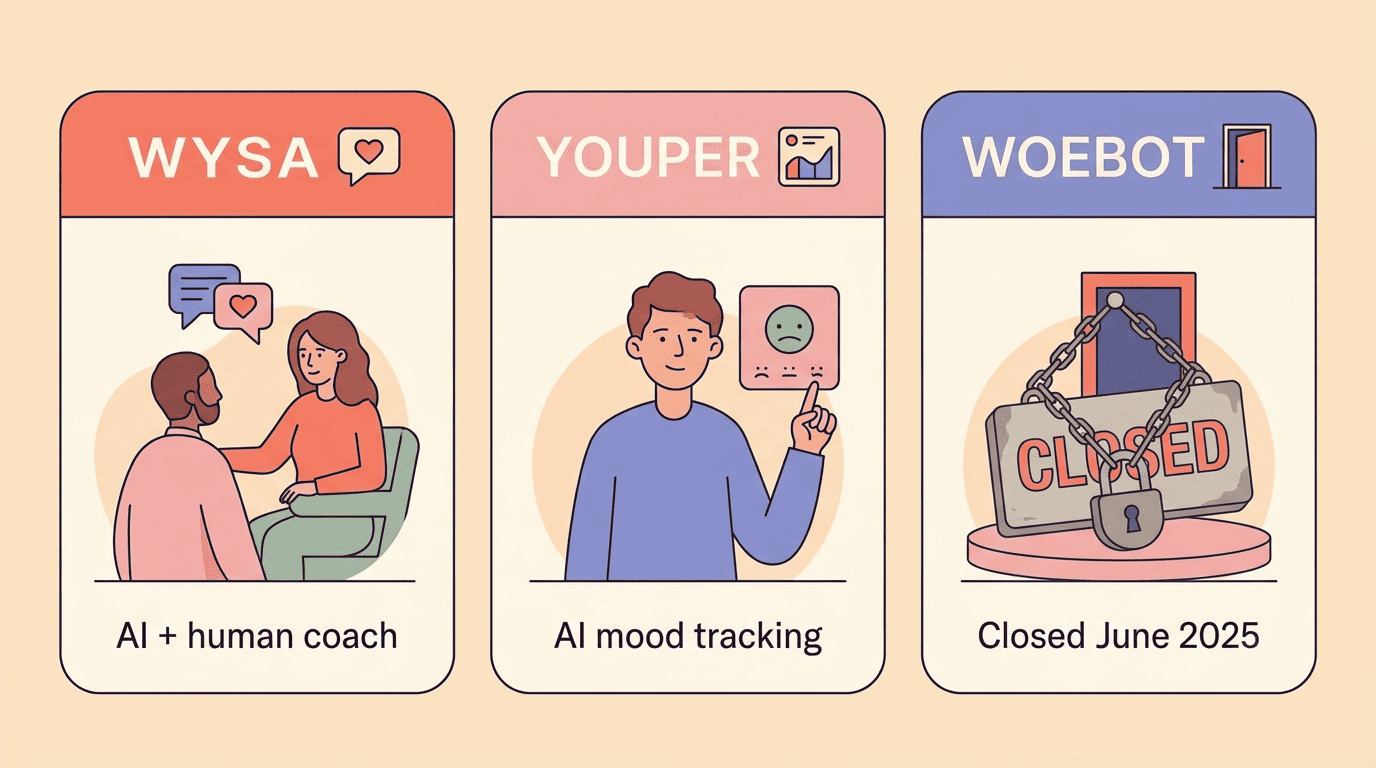
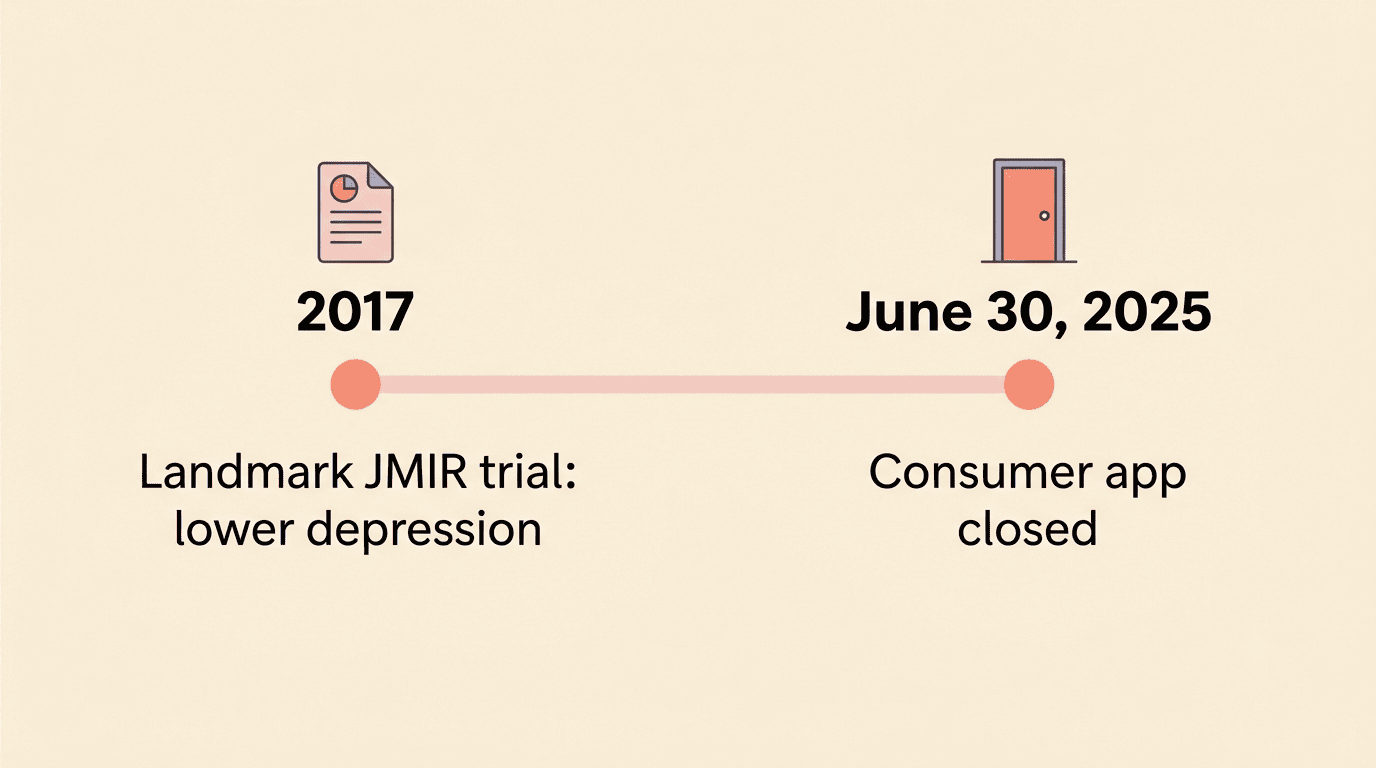
If you’re shopping for an AI psychologist app, three names dominate the conversation — Wysa, Youper, and Woebot. Wysa blends an AI chatbot with optional human coaches, Youper is an AI-only mood-tracking therapist, and Woebot — the CBT pioneer whose 2017 trial was published in JMIR Mental Health — closed its consumer app on June 30, 2025.
This comparison breaks down each app’s approach, features, price, and clinical evidence so you can pick the right fit, and understand where AI support ends and a real clinician begins.

This article is educational, not medical advice. Wysa, Youper, and Woebot are self-help tools; none of them replace a licensed mental health professional. If you are in crisis or thinking about self-harm, call or text 988 (the Suicide & Crisis Lifeline, US), available 24/7.
The Three Apps at a Glance
Wysa, Youper, and Woebot all run on some version of cognitive behavioral therapy (CBT), but they diverge sharply on what happens after the chat window opens — whether a human ever enters the loop, what the subscription costs, and whether the app is even still on the market. Woebot’s disappearance from consumer app stores is the detail that trips up the most people searching for it today.
Quick comparison table
| App | Approach | Human support | Price | Clinical highlight | Status |
|---|---|---|---|---|---|
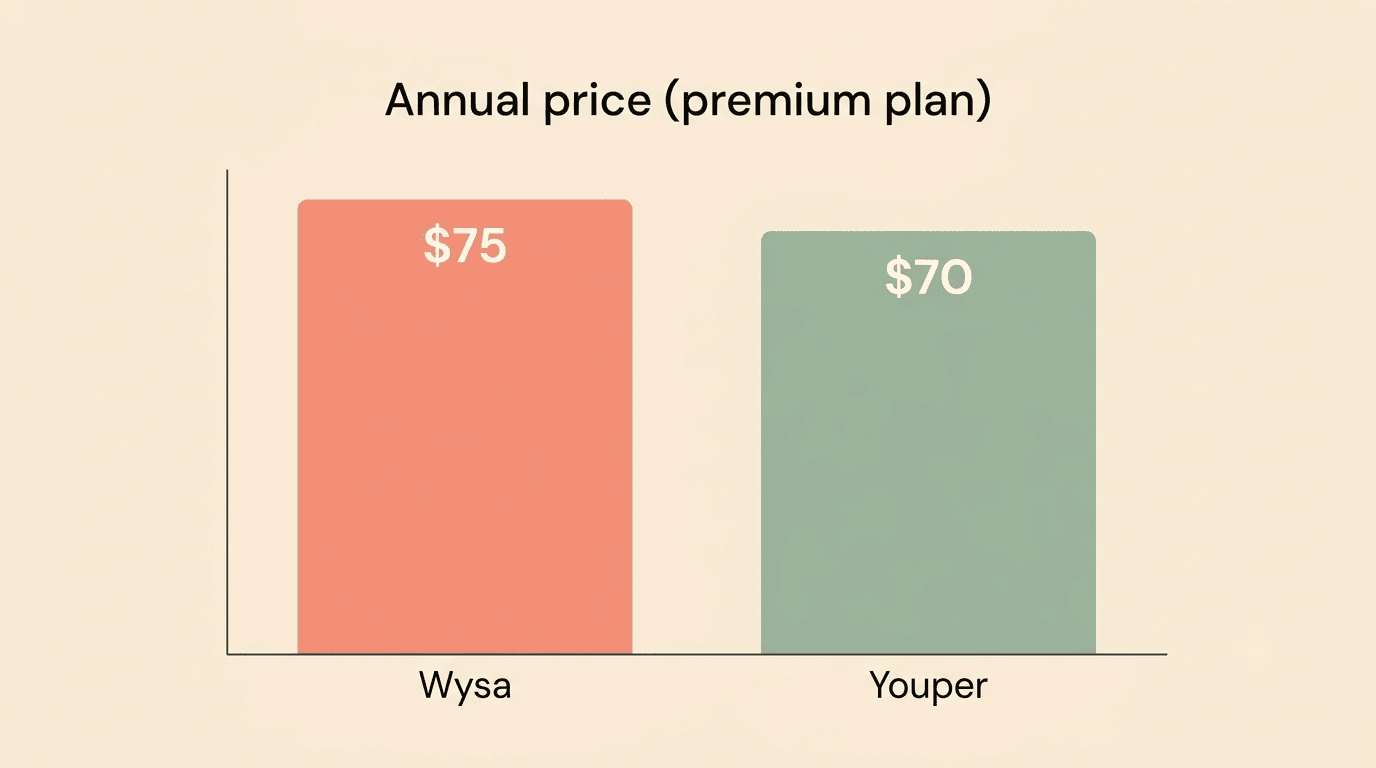
| Wysa | CBT, DBT, and mindfulness + optional human coaches | Yes (paid add-on) | ~$75/year, plus a free tier | FDA Breakthrough Device Designation (May 2022) | Active |
| Youper | CBT, ACT, and DBT + daily mood tracking | No | ~$70/year after a 7-day trial | Vendor-reported depression/anxiety reduction data | Active |
| Woebot | CBT conversational agent | No | Was free (consumer app) | 2017 JMIR randomized controlled trial | Consumer app closed June 30, 2025 |
Dialectical behavior therapy (DBT) skills — distress tolerance, emotion regulation — show up in both Wysa and Youper’s exercise libraries, while Acceptance and Commitment Therapy (ACT) is more central to Youper’s approach. Mood tracking, meanwhile, is Youper’s core loop rather than an add-on feature.
The therapy frameworks behind all three apps break down like this:
- CBT (cognitive behavioral therapy) — reframing unhelpful thought patterns; the base layer for all three apps.
- DBT (dialectical behavior therapy) — distress tolerance and emotion regulation skills, used by Wysa and Youper.
- ACT (acceptance and commitment therapy) — values-based acceptance work, most prominent in Youper.
- Mindfulness and breathing exercises — in-the-moment regulation tools, strongest in Wysa’s library.
Wysa: Hybrid AI Plus Human Coaching
Wysa is built around an anonymous, penguin-avatar chatbot that delivers CBT, DBT, and mindfulness exercises, along with breathing and sleep tools. What sets it apart from a pure chatbot is the option to add a human: licensed coaches who message you asynchronously on paid plans, turning Wysa into a hybrid of self-guided AI practice and real human support rather than an AI-only product.
Approach and features
Wysa’s chatbot walks users through structured CBT and DBT techniques — thought reframing, grounding exercises, mindfulness. The human-coaching layer is opt-in and paid, delivered as text-based check-ins rather than live video sessions, so it functions more like coaching support than formal therapy.
Price and evidence
Wysa’s premium tier runs about $75 a year, with a usable free self-help tier for anyone who just wants the core chatbot and exercise library. In May 2022, Wysa received FDA Breakthrough Device Designation for an AI-based tool targeting depression and anxiety in adults with chronic musculoskeletal pain. That designation, described on the FDA’s Breakthrough Devices Program page, fast-tracks the regulatory review process for devices that show potential for more effective treatment of life-threatening or debilitating conditions — it is a signal of clinical seriousness, not the same thing as full FDA clearance or approval for general use.
Wysa’s toolbox, in short:
- CBT and DBT exercises for reframing thoughts and building distress tolerance
- Guided mindfulness and breathing tools for in-the-moment regulation
- A sleep module for insomnia and wind-down routines
- Optional paid access to licensed human coaches via async text
Youper: AI Mood Tracking and CBT
Youper positions itself as an AI virtual therapist that runs short CBT, ACT, and DBT exercises anchored around daily mood check-ins. It is AI-only — there is no human coach option, which puts more weight on the self-tracking loop as the app’s main value driver.
Approach and features
Daily check-ins are the backbone. Each session opens with a mood rating and a short conversational exercise pulled from CBT, ACT, or DBT, tailored to whatever emotion the user just logged.
Emotion tracking builds a personal pattern. Over weeks of use, Youper’s mood log turns into a trend chart the user (and, in theory, their own clinician) can review — a feature Wysa offers in lighter form but doesn’t center the product around.
No human backstop exists inside the app. Unlike Wysa, there’s no paid coach or clinician layer; everything routes through the AI conversation.
Price and evidence
Youper costs roughly $70 a year after a 7-day free trial, and unlike Wysa it has no permanent free tier — once the trial ends, the core exercises sit behind a paywall. Youper cites its own data suggesting a roughly 48% reduction in depression symptoms and a 43% reduction in anxiety symptoms after four weeks of use. Treat those figures as vendor-reported rather than independently verified: they come from the company’s own studies, not a peer-reviewed randomized controlled trial (RCT) on the scale of Woebot’s, so they’re worth healthy skepticism until replicated by outside researchers.
What that $70/year buys:
- Daily mood check-ins with an AI-generated emotional pattern log
- Short CBT, ACT, and DBT exercises matched to the logged mood
- Trend charts for tracking symptoms over weeks or months
- No human coaching or clinician access at any tier
Woebot: The CBT Pioneer That Left the App Store
Woebot was a fully automated CBT conversational agent — no human coaching, no mood-tracking dashboard, just a chatbot walking users through structured exercises. It’s also the app with the most-cited clinical research behind it, which is exactly why so many people still search for it months after it disappeared.
A landmark in AI therapy research
Woebot’s evidence base traces back to a 2017 randomized controlled trial published in JMIR Mental Health, one of the first rigorous studies of a therapy chatbot. Researchers Fitzpatrick, Darcy, and Vierhile recruited 70 young adults aged 18 to 28, splitting them into a Woebot group (n=34) and a control group that used an e-book instead (n=36). Over two weeks, participants who used Woebot for up to 20 sessions showed a statistically significant drop in depression symptoms on the PHQ-9 scale (F=6.47, P=.01) compared with the control group, according to the full study text on PMC.
Our results suggest that conversational agents may be an acceptable, feasible, and effective way to deliver CBT.
Fitzpatrick, Darcy & Vierhile, JMIR Mental Health (2017)
That small trial became one of the most frequently cited studies in the AI therapy chatbot literature, and it’s a big part of why Woebot built a reputation as the clinically credible option in the category — even after the consumer product stopped shipping.
Why you can’t download it anymore
On June 30, 2025, Woebot Health discontinued its direct-to-consumer app; the underlying technology now lives on only through health systems and enterprise partners rather than a public app-store listing. If you were specifically hoping to try Woebot as an individual consumer, Wysa and Youper are the practical alternatives left standing in the same category.
How to Choose the Right AI Psychologist App
Since Woebot is no longer available to individual users, the real decision for most people is between Wysa and Youper — and that choice comes down to whether a human safety net matters more to you than a tight mood-tracking loop.
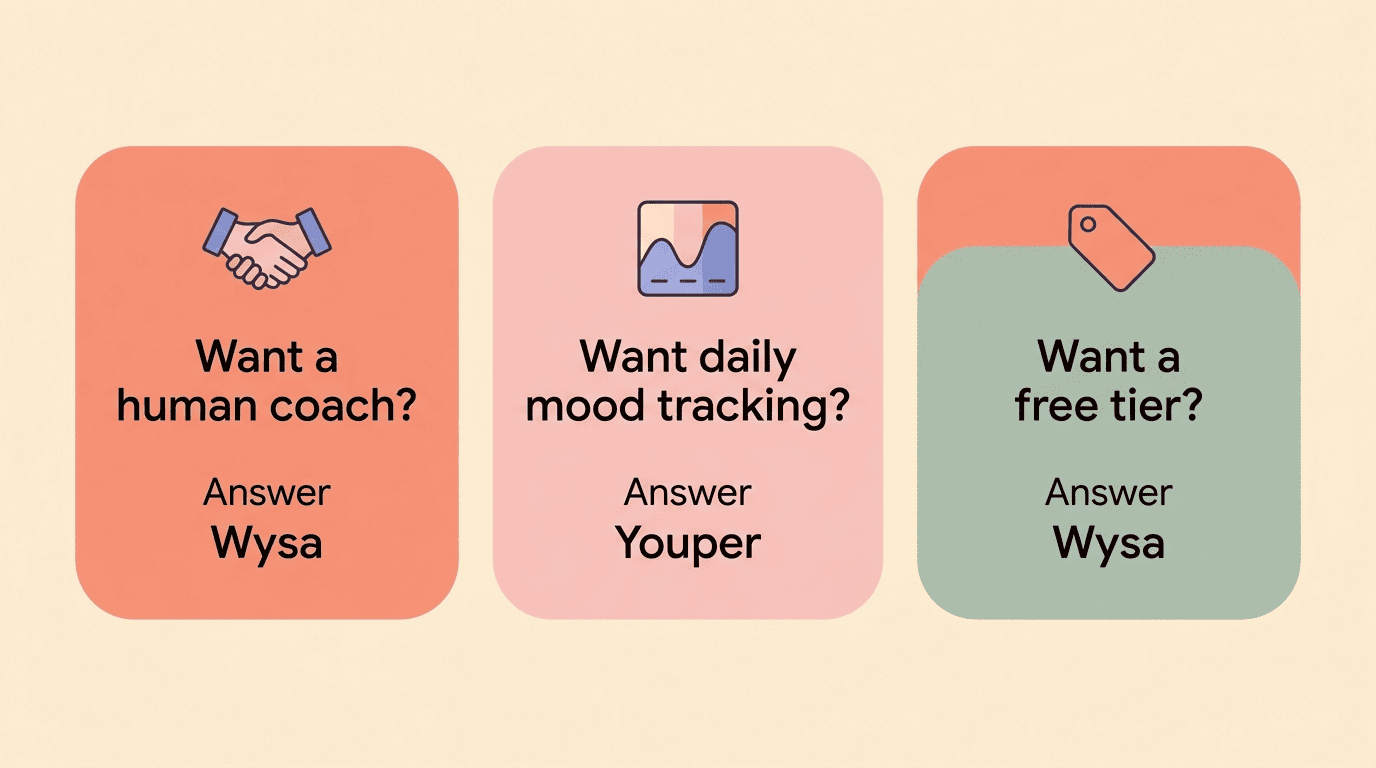
| If you want… | Best fit |
|---|---|
| An optional human coach alongside the AI | Wysa |
| A free tier to try before paying anything | Wysa |
| Daily mood tracking as the core habit | Youper |
| The most regulatory recognition (FDA Breakthrough) | Wysa |
| Clinician-delivered care through a health plan | Ask if Woebot is offered enterprise-side |
Match the app to your need
Here’s a simple way to work through the decision:
- Decide whether you want an optional human coach in the loop — if yes, Wysa is the only one of the two that offers it.
- Consider whether daily mood tracking and quick check-ins are your priority — Youper is built specifically around that habit.
- Check your budget: Wysa’s free tier lets you try the core chatbot at no cost, while Youper requires payment after a 7-day trial.
- Look for FDA Breakthrough Device status if regulatory signal matters to you — currently only Wysa holds it.
- Ask whether your health plan offers Woebot through a clinical partner, since the consumer app itself is gone.
- Remember that all of these are complements to, not replacements for, professional treatment.
Where every app stops
None of these apps can diagnose a condition, handle an active crisis, or replace a licensed mental health professional. Use them for skills practice and daily reflection, and get human help for anything severe, worsening, or safety-related — starting with 988 if you’re ever in crisis.
Signs it’s time to go beyond an app and reach a licensed professional:
- Symptoms are worsening rather than improving after several weeks of consistent use
- Thoughts of self-harm or suicide appear, even briefly — call or text 988 immediately
- Daily functioning (work, sleep, relationships) is breaking down
- A diagnosis, medication evaluation, or formal treatment plan is needed