
AI Psychologist: Free, Private Support to Understand Yourself 24/7
An AI psychologist is an AI-powered chat that listens without judgment, helps you make sense of what you feel, and guides you through evidence-based coping techniques — and you can talk to an AI psychologist right here, free and private, any time of day or night. According to the American Psychological Association, a growing share of people already turn to AI for emotional support between — or instead of — formal sessions. It is supportive self-help, not a licensed clinician: it does not diagnose, prescribe, or handle emergencies.
If you are in crisis or thinking about harming yourself, this chat is not the right tool — call or text the 988 Suicide & Crisis Lifeline (free, confidential, 24/7 in the US), or call 911.
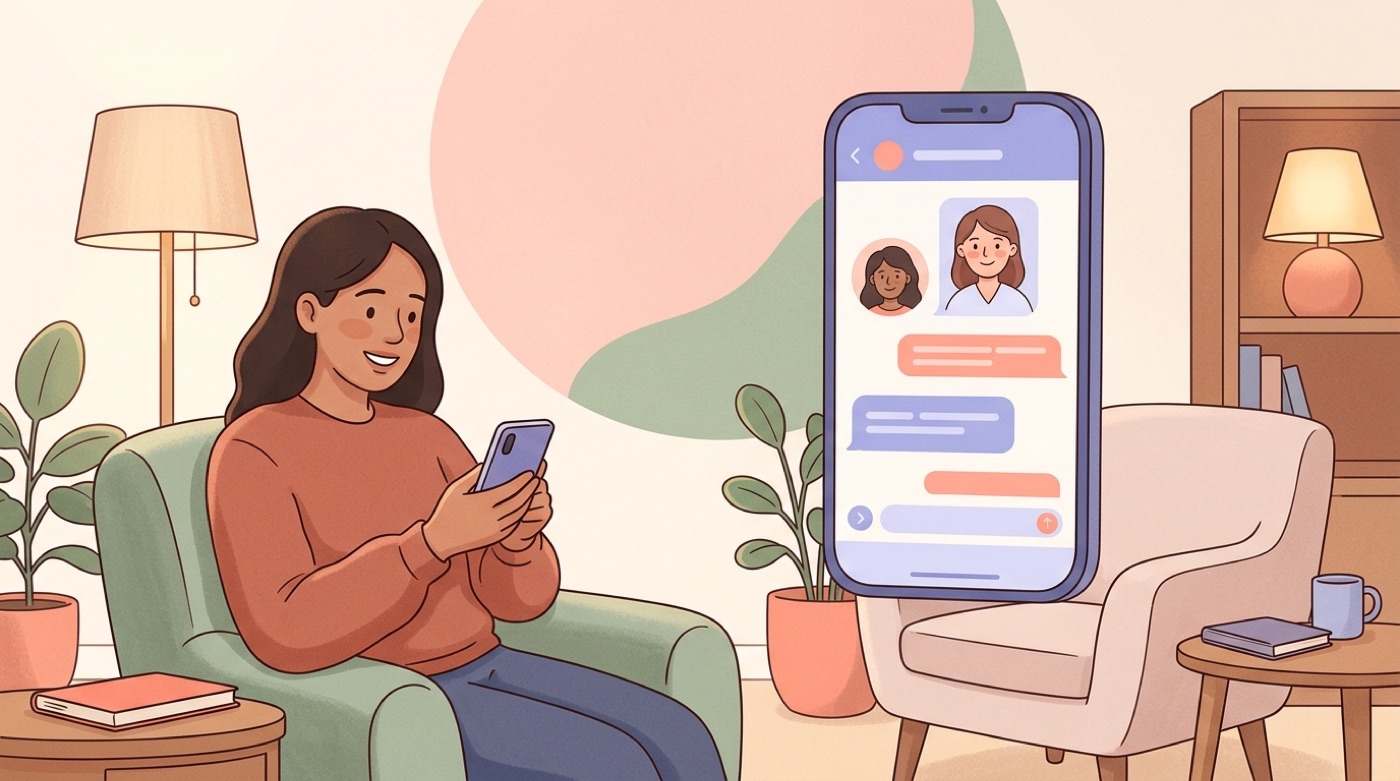
What is an AI psychologist?
An AI psychologist — also called an AI therapist or AI mental-health chatbot — is a conversational AI you can message like a caring listener whenever a thought is too loud to sit with alone. The idea is not new: the first therapy chatbot, ELIZA, dates back to 1966 and simply mirrored a person’s words back to them. What changed is that modern large language models made the conversation genuinely responsive, remembering context and adapting tone within a single chat.
The shift shows up in the numbers. Per the APA, 77% of psychologists have spoken with patients who used AI for support, engagement, or other reasons, and more than a third (35%) describe it as an additional mental-health professional alongside therapy. It is worth separating two things: general-purpose chatbots like ChatGPT, Gemini, or Claude were never built for care, even though they have become one of the largest informal sources of emotional support simply through sheer availability. Purpose-built tools such as an AI psychologist chat are designed specifically around emotional support, reflective listening, and structured self-help, which changes both the guardrails and the experience.
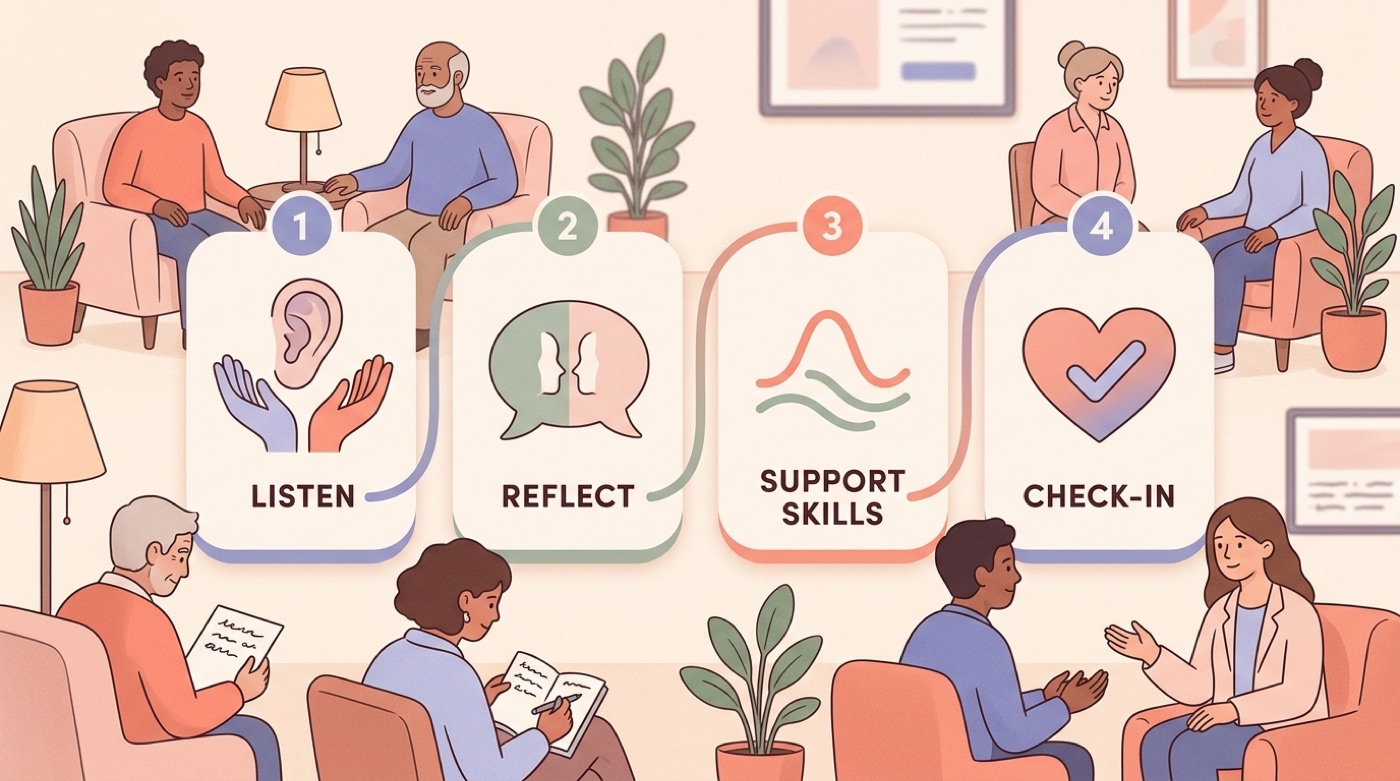
How an AI psychologist works
Every conversation follows a similar loop, whether the topic is a rough day at work or a recurring worry that will not settle. It listens actively first. Rather than jumping to advice, it reflects back what you said in your own words so you feel heard before anything else happens. Then it offers a technique when it fits — never forced, never generic — drawn from established practice rather than improvised.
The techniques themselves are simple to name in plain language:
- Cognitive reframing, the core tool of CBT, for catching and questioning unhelpful thought patterns
- Distress-tolerance and emotion-regulation skills, borrowed from DBT, for moments that feel overwhelming
- Slow, paced breathing to calm the nervous system in real time
- 5-4-3-2-1 grounding, which walks attention through five senses to interrupt spiraling thoughts
- Journaling prompts that turn a vague feeling into something you can actually look at
Some tools in this space go further with structured tracking — for instance, one popular AI therapist app pairs CBT conversation with standardized mood scales like the BDI and GDS to chart how a person is doing over time. Throughout, the chat checks in periodically and adapts its pace to how much you want to share, rather than pushing a fixed script.

What an AI psychologist can help with
The everyday concerns people bring to an AI psychologist are rarely dramatic — they are the ordinary weight of daily life. Anxiety and stress top the list, alongside low mood, shaky self-esteem, and the friction of relationship conflict. Sleep problems, burnout, and simply making sense of a hard day round out the picture.
| Concern | What the AI psychologist offers |
|---|---|
| Anxiety and stress | Grounding exercises, breathing techniques, reframing anxious thoughts |
| Low mood and self-esteem | Reflective listening, journaling prompts, gentle CBT reframing |
| Relationship conflict | A space to process feelings before a difficult conversation |
| Sleep problems | Wind-down routines and calming grounding practices |
| Burnout and overwhelm | Structured check-ins and pacing support |
This matches what clinicians themselves observe: per the APA, the most common patient uses of AI are managing anxiety and depression symptoms, coping with relationship conflict, and generally improving well-being. These are everyday, non-crisis concerns — the kind of support that fits naturally between therapy sessions or for people not yet in therapy at all, not a substitute for treating a diagnosed condition.
Do AI psychologists actually work?
The honest answer sits between skepticism and hype, and it is worth looking at both sides before deciding whether to trust one.
The evidence for benefit is real, not anecdotal. The first randomized controlled trial of a purpose-built therapy chatbot — Dartmouth’s Therabot, published in NEJM AI in March 2025 — reported meaningful reductions in depression and anxiety symptoms among the 210 participants after four weeks, with effect sizes researchers compared favorably to benchmark psychotherapy trials. It is a single trial, and researchers note it needs independent replication before those results can be called established.
The caveats matter just as much. A review in Frontiers in Psychiatry notes that the benefits people experience from AI chatbots can diminish over time rather than compounding the way ongoing human therapy often does. More concerning, 2025 research that scored how six leading AI chatbots handle mental-health crises found wide, inconsistent gaps in safety — several models fell below acceptable safety thresholds, and even the strongest performers did not consistently sustain the conversation or offer concrete next steps.
These systems must be carefully designed and implemented to complement rather than replace the critical human elements of empathy, cultural competence, and nuanced understanding in therapy.
Frontiers in Psychiatry — Can AI Replace Psychotherapists?
Taken together, the research points to a clear middle ground: promising for everyday, low-stakes emotional support, but not a substitute for professional treatment when symptoms are severe or safety is a concern.

Is an AI psychologist safe?
Safety here has two separate dimensions, and both deserve a straight answer rather than reassurance for its own sake.
Accuracy and privacy risks
AI can be wrong, can miss subtle crisis signals a trained clinician would catch, and raises legitimate data-privacy questions about what happens to sensitive conversations. Psychologists themselves are far from complacent about this — a 2025 APA survey found 92% cite concerns about AI in mental-health contexts, breaking down into:
- Data breaches or misuse of sensitive conversations — 67% concerned
- Broader social harms from AI in mental health — 64% concerned
- Algorithmic bias affecting the quality of support — 63% concerned
Independent testing backs this caution up — chatbots have been shown to respond inappropriately in at least one in five interactions touching on sensitive topics. That is not a reason to avoid an AI psychologist for everyday reflection, but it is a reason to keep expectations realistic and to stay alert to how a conversation is actually going.
What to do in a crisis
On the crisis question, the line is absolute. An AI psychologist is not a crisis service. If you are having thoughts of suicide or self-harm, or you are worried about someone else’s safety, contact the 988 Suicide & Crisis Lifeline — call or text 988, free and confidential, 24/7 — or call 911 in an emergency. A short routine helps turn that into something you can actually follow under stress:
- Treat the AI chat as a complement to professional care, never a replacement for it
- Avoid sharing identifying details you would not want stored anywhere
- Notice if the same difficult feeling keeps returning — that is a signal to loop in a licensed clinician
- Save the 988 Lifeline number somewhere you will actually see it, before you need it
- Leave the chat immediately and call 988 or 911 if you are ever in real danger
None of this makes an AI psychologist unsafe to use for the everyday concerns it was built for — it simply means treating it like what it is: a supportive listener, not an emergency responder.

AI psychologist vs a human psychologist
Neither one is trying to replace the other, and the comparison is clearer once the roles are laid out side by side.
| AI psychologist | Human psychologist | |
|---|---|---|
| Availability | 24/7, instant | Scheduled appointments |
| Cost | Free or low-cost | Typically $100–$250+ per session |
| Privacy | Anonymous, no records shared with an employer or insurer | Confidential but part of a formal medical record |
| Diagnosis and treatment | Cannot diagnose or prescribe | Licensed to diagnose, treat, and prescribe (with a psychiatrist) |
| Crisis handling | Not equipped — refers to 988/911 | Trained to assess and manage risk |
| Best for | Daily reflection, coping skills, processing feelings | Diagnosed conditions, complex history, ongoing accountability |
The most useful way to think about it: an AI psychologist fills the gaps between sessions — the 2 a.m. spiral, the argument you need to process before you can sleep — while a human psychologist carries the parts AI legally and clinically cannot, including diagnosis, prescribing, and crisis intervention. Used together, they complement rather than compete.
A few signals it is time to bring a licensed psychologist into the picture, even if an AI psychologist stays part of the routine:
- Symptoms are persistent, severe, or interfering with work, school, or relationships
- You suspect a diagnosable condition rather than everyday stress
- Medication might be part of the picture, which requires a licensed prescriber
- You have thoughts of harming yourself or someone else
- Progress has stalled and you want accountability and a treatment plan
Is there a free AI psychologist?
Yes — you can start free right here, with no sign-up required. The wider AI-therapy market has moved toward optional subscriptions once you want extra features: one well-known AI therapist app charges around $18.99 a month, while another prices its free tier alongside a Pro plan at $19.99 monthly, or roughly $8.25 a month billed annually. Basic supportive chat, however, remains free across most of the category, including here.
Paid tiers in this space typically add:
- Voice mode for spoken conversations instead of typing
- Longer memory that carries context across multiple sessions
- Unlimited daily messages instead of a capped free quota
- Mood-tracking dashboards or progress scales over time
Frequently Asked Questions
- Is there an AI psychologist I can talk to right now?
Yes — you can start chatting free on this page, no sign-up, 24/7. It listens, helps you reflect, and shares coping techniques.
- Can an AI psychologist replace a real psychologist?
No. It is supportive self-help and complements professional care, but it cannot diagnose, prescribe, or handle crises — see a licensed clinician for those.
- Is AI therapy safe?
For everyday reflection, generally yes, but AI can be wrong and can miss crisis signals. Never rely on it in an emergency — call or text 988 or call 911.
- Do AI mental health chatbots actually work?
Evidence is promising: Dartmouth’s randomized Therabot trial reported meaningful symptom reductions, though experts caution benefits can fade and chatbots aren’t crisis-ready.
- Is there a free AI psychologist?
Yes — basic supportive chat here is free with no account. Some apps add optional subscriptions for extra features.
- What should I do in a crisis?
Contact the 988 Suicide & Crisis Lifeline (call or text 988), call 911, or go to your nearest emergency room. An AI psychologist is not a crisis service.