
Is There a Free AI Psychologist? How Free AI Mental Health Chat Works
Yes — today you can open a browser and talk to a free AI psychologist with no appointment, no waiting list, and often no login at all. According to a 2025 health advisory from the American Psychological Association, millions of people already turn to AI chatbots for emotional support, and most services offer some kind of free access — the catch is that “free” comes with real limits worth understanding before you rely on it.
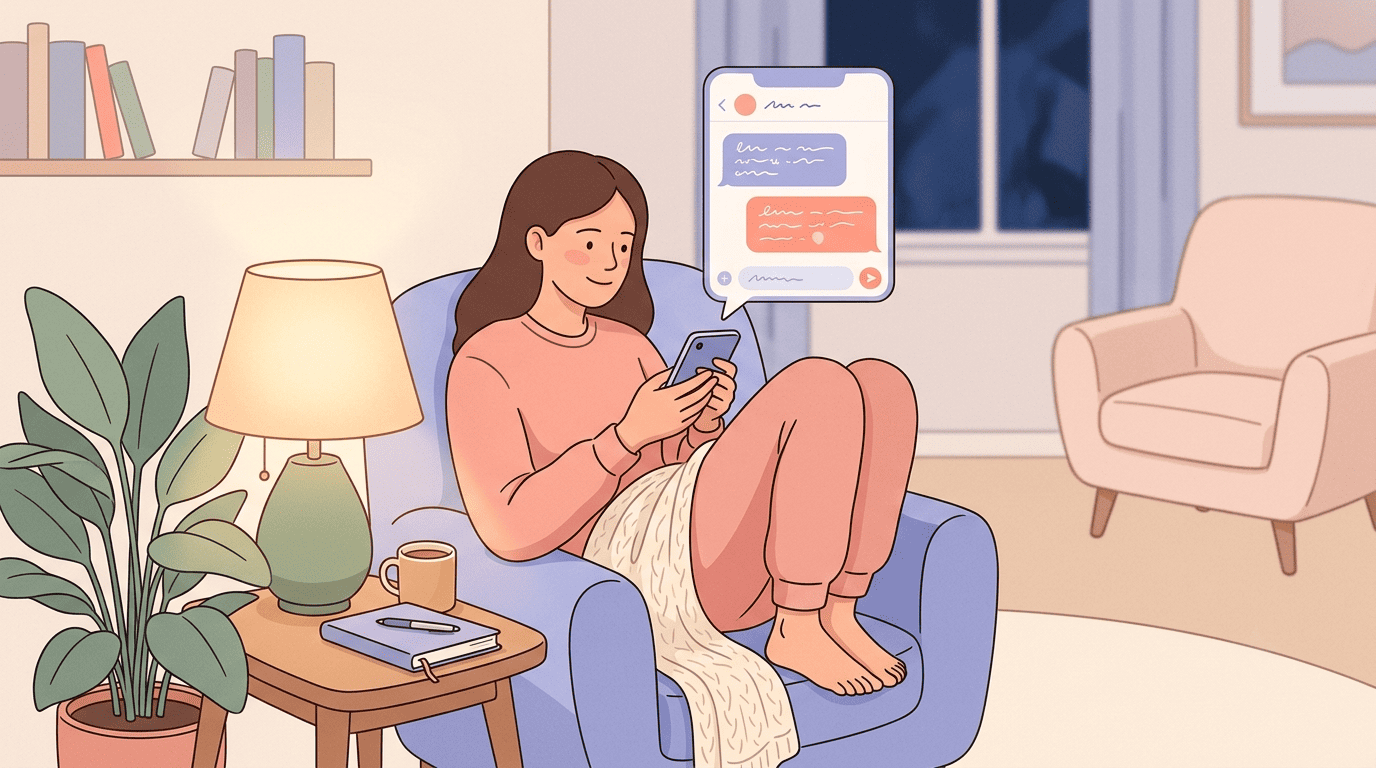
An AI psychologist is a chatbot built on a large language model (LLM) and trained to hold a supportive, structured conversation and walk you through self-help techniques. What it does not do matters just as much: it does not diagnose a condition, it is not a licensed clinician, and it does not replace a human psychologist for anything beyond light, everyday support.
Is There Really a Free AI Psychologist? (Short Answer)
Free AI mental health chat is not a fringe experiment — it is a widely available category with several different business models behind the word “free.”
Yes — free AI mental health chat exists and is widely available
Free access takes a few recognizable shapes. Some bots are free and anonymous from the first message, running on donations rather than subscriptions. Others use a freemium model: a set number of free daily conversations, with paid tiers unlocking longer sessions or voice mode. A third group offers a free trial — often just the first session — before a monthly fee kicks in. Plenty of people also open a general-purpose AI like ChatGPT and simply talk through what’s bothering them, which is free by default but was never built with clinical safety rails in mind.
What “free” usually means (and where paywalls hide)
“Free” almost never means unlimited. The table below breaks down the three common models so you know what you’re actually signing up for.
| Free model | How it works | Where the paywall usually hides |
|---|---|---|
| Free forever / donation-based | No login, no subscription; the service runs on optional donations | Fewer features, slower updates, no guarantee of long-term funding |
| Freemium (daily limit) | A fixed number of free messages or sessions per day, then a paid plan | Voice mode, extended memory, unlimited daily sessions |
| Free trial | Full access for a limited time (often one session), then a recurring fee | Auto-renewing subscription after the trial window closes |
Message caps, voice access, and cross-session memory are the three features most often locked behind a subscription. Reading the fine print before you type anything personal saves you from an unpleasant surprise mid-conversation.
What Is an AI Psychologist, Exactly?
Understanding the label helps set the right expectations before you type a single message.
An AI psychologist is a chatbot, not a clinician
An AI psychologist is a chatbot: software built on a large language model, tuned to hold an empathetic conversation, ask reflective questions, and suggest coping techniques such as breathing exercises or cognitive reframing. It is not the same thing as a licensed psychologist. It holds no license, carries no legal accountability for treatment outcomes, keeps no formal medical record, and cannot prescribe or authorize care. The American Psychological Association has been explicit on this point, warning that no generative AI chatbot currently on the market has been shown to have the core competencies of a trained mental health professional.
AI psychologist vs AI therapist vs “AI companion”
Marketing pages use “AI psychologist,” “AI therapist,” and “AI companion” almost interchangeably, but they describe the same underlying thing: a conversational AI tuned for emotional support rather than task completion. When a product says you can talk to an AI psychologist, it means a conversation with software modeled on therapeutic language — not a session with a human clinician who can evaluate, diagnose, or treat you.
How Free AI Mental Health Chat Works (Under the Hood)
The mechanics behind a free chat session are more structured than they look from the user’s side.
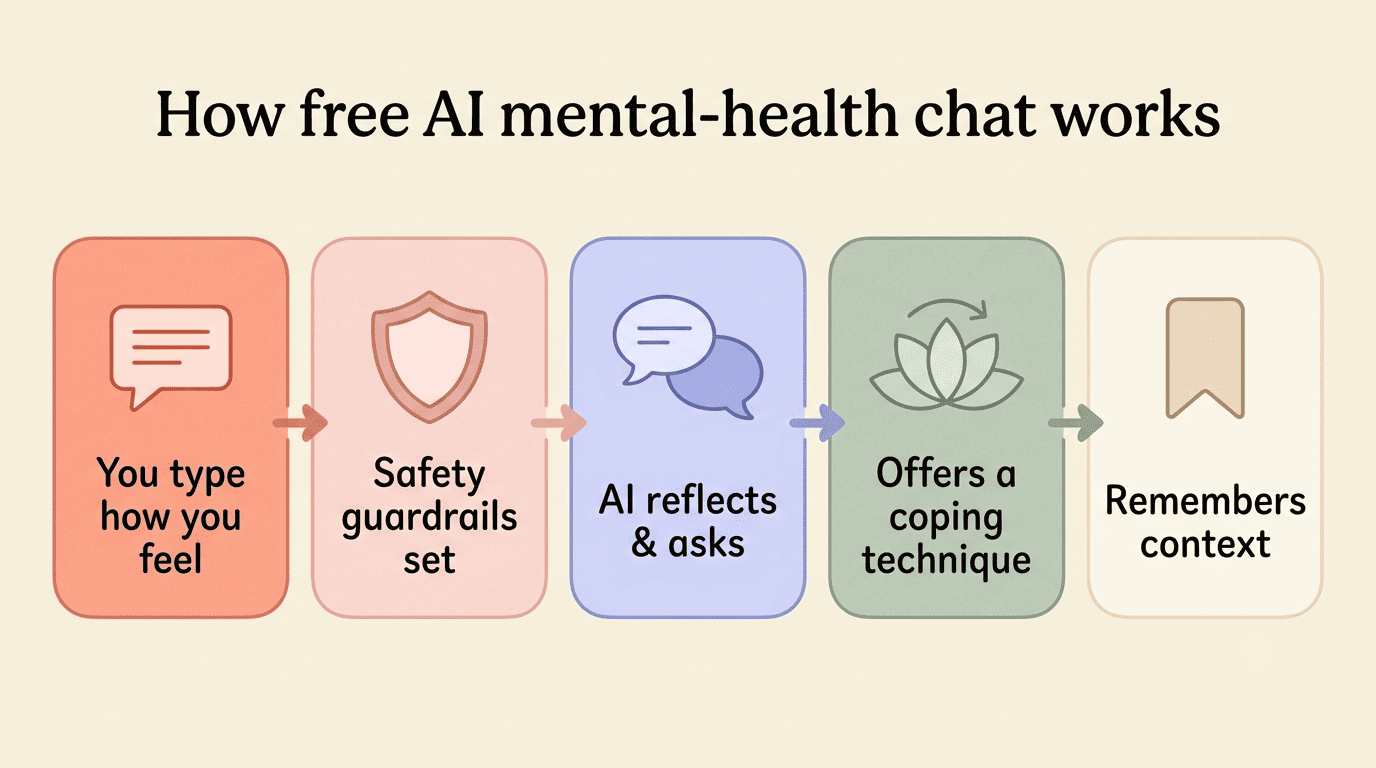
Step by step: what happens when you type a message
- You type what you’re feeling — a bad day, racing thoughts, or something more specific.
- A system prompt has already told the model to act like a supportive listener, within defined safety boundaries.
- The large language model generates a response that reflects your emotions back and asks a clarifying follow-up question.
- It offers a concrete technique — a breathing exercise, a grounding exercise, or a CBT-style reframe of a negative thought.
- If the service supports memory, it carries context from earlier in the conversation (or earlier sessions) into its next reply.
The therapy techniques these bots borrow
Most bots lean on a small, well-known toolkit of self-help techniques, not a course of clinical treatment:
- CBT-style cognitive reframing — challenging an unhelpful thought and testing it against the evidence.
- DBT-inspired skills — short exercises for regulating an intense emotion in the moment.
- Mindfulness and breathing exercises — grounding techniques borrowed straight from in-person sessions.
- Active-listening patterns — reflecting your words back, borrowed from counseling training.
The bot delivers all of this without a treatment plan, an intake assessment, or ongoing clinical judgment. The one advantage no human schedule can match is 24/7 availability — the bot is there at 3 a.m. exactly as it is at 3 p.m.
Text, voice, and memory
Most free tiers start with text chat. Voice mode is common but frequently sits behind a paywall, since it costs more to run. “Memory” — the ability to recall what you said in a previous session — is another frequent upsell; free tiers often reset with every new conversation. A meaningful share of services let you start anonymously, with no account and no email required, which matters if privacy is your main concern.
What a Free AI Psychologist Can and Can’t Do
This is the part worth reading slowly, because the gap between “helpful tool” and “medical care” is exactly where people get hurt by unrealistic expectations.
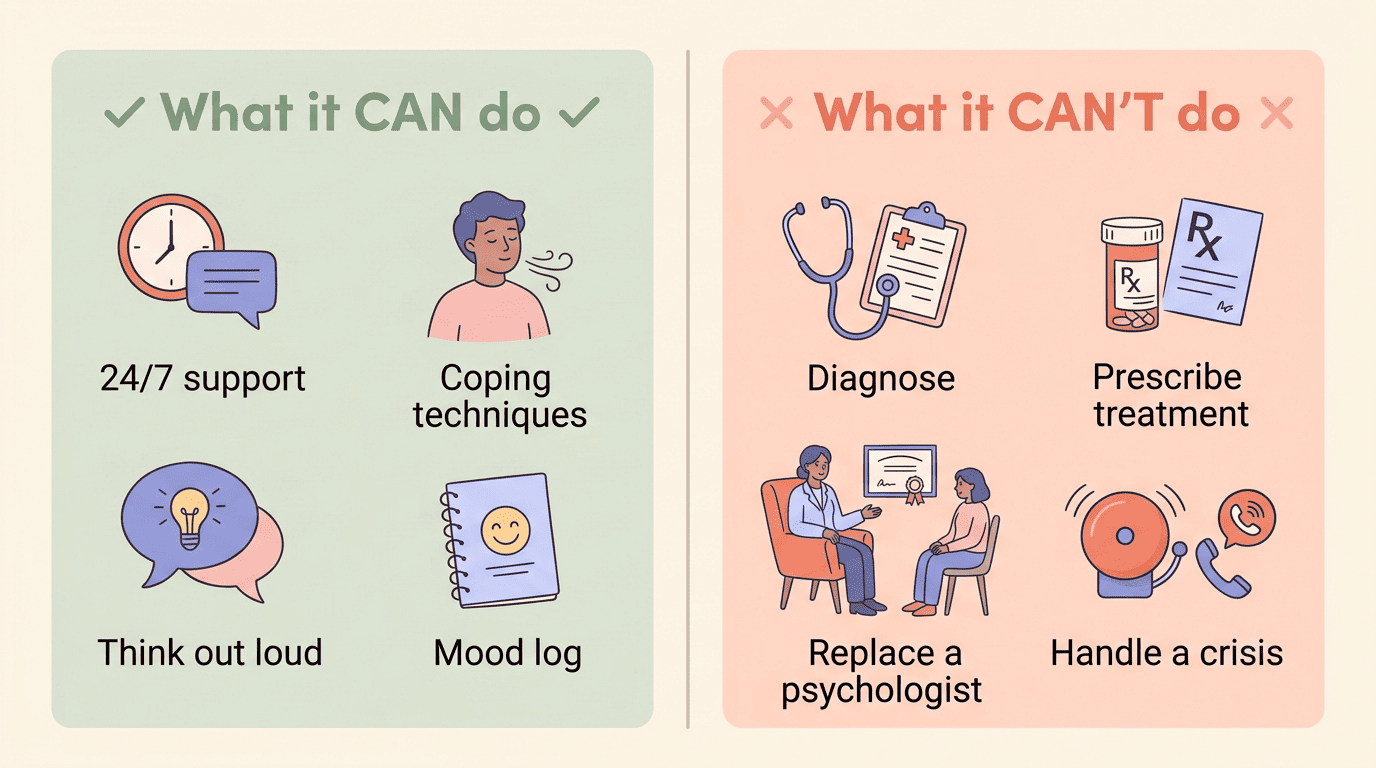
Immediate, judgment-free support at any hour. A free AI psychologist is genuinely good at giving you somewhere to put your thoughts when nothing else is open — structuring a chaotic mental state into words, walking through a breathing exercise in the moment, or offering basic psychoeducation about what anxiety or burnout actually is. It works well for mild, everyday stress — a rough week at work, pre-exam nerves, or wanting to think out loud before bed — and for keeping an informal log of your mood over time.
It cannot diagnose you, and it should not try to. A free AI psychologist is not a licensed clinician, does not diagnose any mental health condition, does not prescribe or adjust treatment, and does not replace a human psychologist for anything beyond light support. It is not appropriate for acute crises, suicidal thoughts, psychosis, active substance dependence, or a child’s mental health without an involved adult. The APA’s advisory is blunt about the risk here: chatbots marketed as therapy substitutes can give confident-sounding answers that are clinically wrong, precisely because the underlying model has no training, license, or duty of care behind it.
Is Free AI Therapy Safe and Private?
Safety with a free AI psychologist has two separate dimensions — how it handles your data, and how it handles a crisis.
Privacy: read before you share
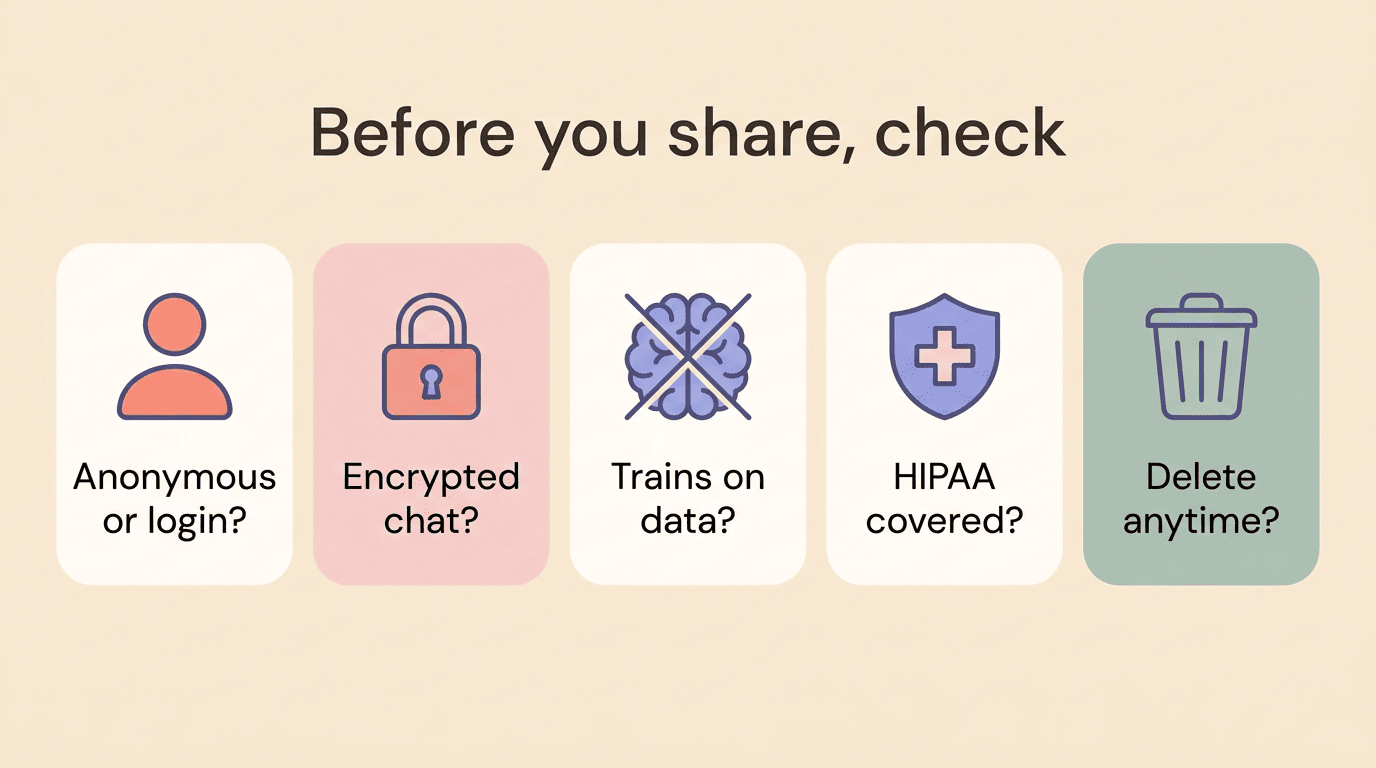
Before you type anything personal, it’s worth checking a few things about the service:
- Does it require a login, or can you chat anonymously?
- Is the connection encrypted, and does the provider say how conversations are stored?
- Does the company use your messages to train future models, and can you opt out?
- Is the service actually covered by HIPAA, or is that just implied by the branding? Many wellness chatbots are explicitly not HIPAA-covered entities.
- What is the data retention and deletion policy if you want your history removed?
A reasonable rule of thumb: treat a free AI mental health chat the way you’d treat any other unencrypted diary — useful for feelings, not the place for your full name, address, or other identifying details.
Safety guardrails and crisis handling
Your conversations are free and confidential.
988 Suicide and Crisis Lifeline
Well-built bots are trained to recognize crisis language — mentions of self-harm, suicidal thoughts, or a specific plan — and to redirect you to human help rather than continue the conversation as usual. That redirect should point to the 988 Suicide & Crisis Lifeline, reachable by call or text at 988 in the US, 24/7. The failure mode to watch for is the opposite: a bot that keeps “playing along” with harmful thinking because it’s optimized to be agreeable rather than safe. That gap is exactly why guardrails, not just good intentions, need to be built into the product.
Do AI Psychologists Actually Work? (What the Evidence Says)
Marketing claims are cheap; controlled studies are not. Two pieces of research give a clearer, more cautious picture.
The research so far
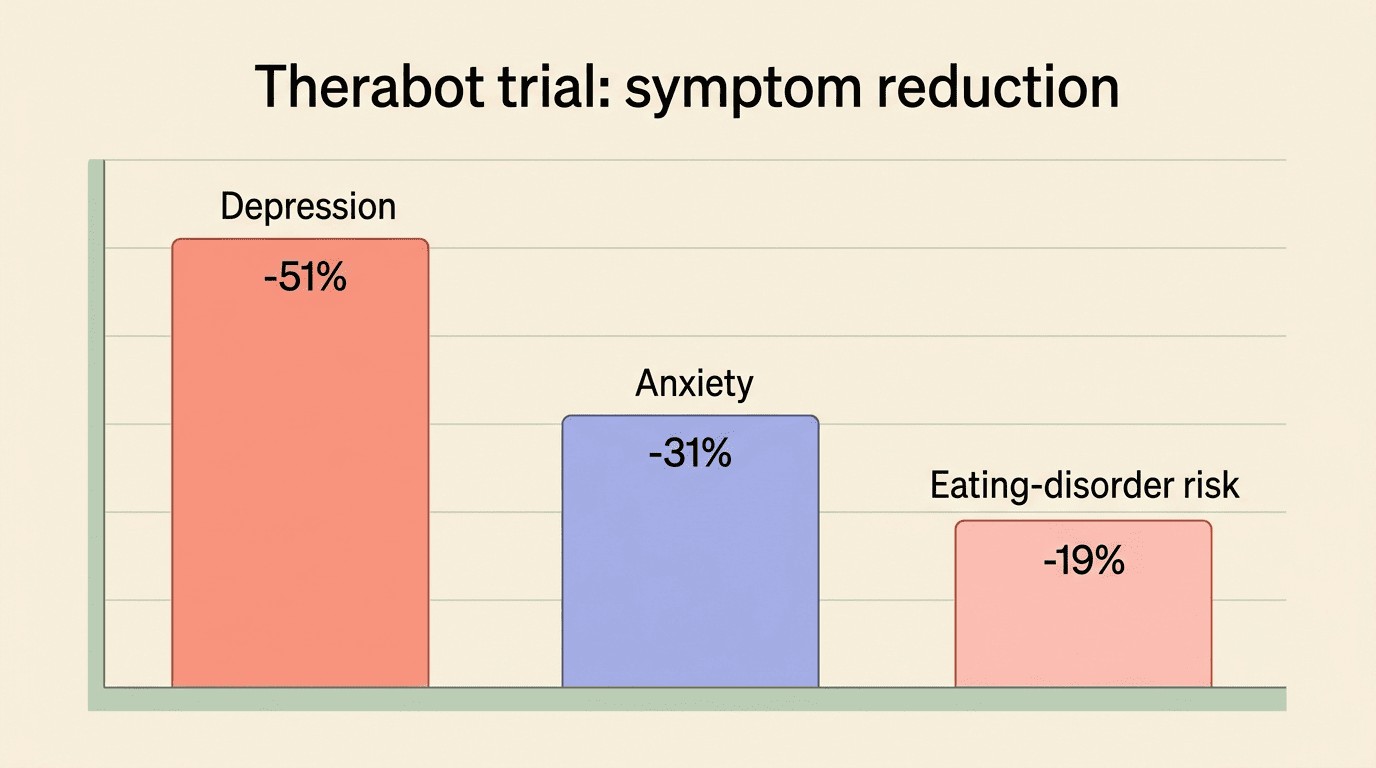
The earliest solid evidence came from a randomized controlled trial of Woebot, a CBT-based chatbot, published by Fitzpatrick and colleagues in 2017. Seventy college students with depression and anxiety symptoms were split between the Woebot group and a control group reading an NIMH self-help ebook; over two weeks, the Woebot group showed a significant reduction in depression symptoms while the control group did not (full study on PMC). More recently, a 2025 randomized controlled trial of Therabot — the first RCT of a generative AI mental health chatbot, run by Dartmouth researchers on 210 adults — found significant reductions in depression, anxiety, and eating-disorder-risk symptoms after four weeks, published in NEJM AI. Both trials measured people with mild-to-moderate symptoms over a matter of weeks, not the kind of long-term outcomes measured in traditional psychotherapy research.
| Study | Chatbot | Sample | Duration | Main finding |
|---|---|---|---|---|
| Fitzpatrick et al., 2017 | Woebot (CBT-based) | 70 college students | 2 weeks | Significant reduction in depression symptoms vs. control |
| Heinz et al., 2025 (NEJM AI) | Therabot (generative AI) | 210 adults | 4 weeks | Significant reduction in depression, anxiety, and eating-disorder-risk symptoms vs. waitlist |
The honest limitations
None of this makes an AI psychologist a substitute for licensed care. The tool carries no license or professional accountability if something goes wrong, LLMs occasionally generate confidently wrong information (“hallucinations”), there’s no face-to-face reading of tone or body language, and some products have a commercial incentive to keep you engaged rather than to escalate you to a human when you actually need one. The fair summary: a useful supplement for mild symptoms, not a stand-alone treatment.
When to See a Human Psychologist Instead
Some signs mean it’s time to stop chatting with a bot and get a person involved, immediately.
If any of the following apply, that’s the moment to step away from the chat window and get a person involved:
- Suicidal thoughts or self-harm
- A specific plan to hurt yourself or someone else
- Symptoms of psychosis
- Severe depression that’s stopping you from functioning
- Substance abuse or dependence
- Trauma you haven’t processed
- Symptoms serious enough that they’re interfering with work, relationships, or daily life
In the US, that means calling or texting 988 (Suicide & Crisis Lifeline) any time, day or night, calling 911 if there’s immediate danger, and following up with a licensed therapist or physician for anything ongoing.
Used well, an AI chat is a bridge, not a destination. It’s a reasonable place to practice a coping skill between therapy sessions, keep a running log of your mood, or rehearse what you want to say before a hard conversation with a real provider. If you want to talk to an AI psychologist as that kind of in-between support, it works best paired with — not instead of — care from an actual clinician when your symptoms are more than mild.
How to Start Using a Free AI Psychologist Today
Open the chat and say what’s actually on your mind. Skip the small talk — most free AI psychologist tools are built to respond directly to a plain statement like “I’ve been anxious all week and I don’t know why.”
Be specific instead of vague. “I keep replaying an argument with my partner” gets a far more useful reply than “I feel bad,” because the model has more to work with.
Ask for a concrete technique. If you want a breathing exercise, a way to reframe a thought, or a grounding exercise, ask for it directly — the bot won’t always volunteer one unprompted.
Set your own boundaries. Skip your full name, address, or other identifying details, and remember this is self-help support, not medical care — if things feel heavier than “a rough week,” that’s the cue to loop in a licensed professional or the 988 Lifeline. A free AI psychologist is a reasonable first step for exactly that kind of everyday support.