
How an AI Psychologist Can Help With Anxiety
If anxiety spikes at 2 a.m. and your next appointment is weeks away, an AI psychologist for anxiety — a conversational app built on research-based methods like CBT — can walk you through the moment right then. According to a Frontiers in Artificial Intelligence review, it won’t diagnose you or replace a therapist, but a growing body of trials shows it can meaningfully lower everyday anxiety when used the right way.
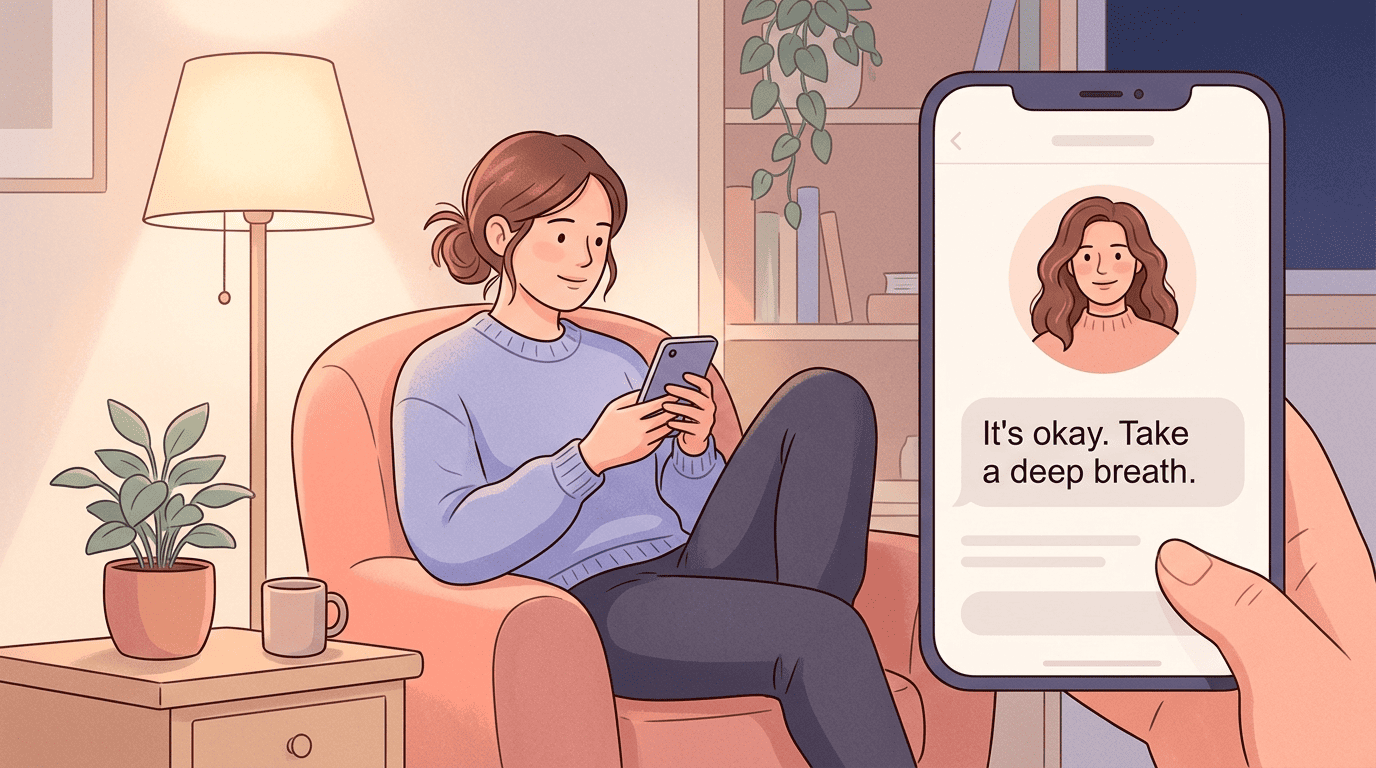
This guide covers what an AI psychologist actually is, how it eases anxiety day to day, what the science says about how well it works, who it fits best, and where it must never be used instead of a human. One note up front: this is educational content, not medical advice, and it isn’t a substitute for a licensed clinician.
What an AI Psychologist Actually Is
An AI psychologist is not a doctor with a license plate on the wall — it’s software trained to talk you through anxious moments using techniques a real therapist would recognize.
A smart, conversational tool — not a doctor
An AI psychologist is a chatbot or app that uses natural language processing (NLP) to interpret what you type and respond with evidence-based techniques — CBT reframing, grounding exercises, psychoeducation. Some of the best-known examples take very different approaches: Woebot and Wysa are rule-based, following scripted, clinically vetted conversation flows, while newer generative tools like Therabot produce more free-form, adaptive replies. What none of them do is diagnose a condition or act as a licensed clinician — they’re a support layer, not a substitute for one.
Rule-based vs. generative AI
The distinction between rule-based and generative AI therapy chatbots matters for safety, not just style. Scripted CBT bots like Woebot and Wysa follow pre-approved decision trees, so their responses are predictable and harder to derail. Generative bots — Therabot, and general-purpose models like ChatGPT or Claude used informally for support — produce open-ended answers that feel more like a real conversation but carry higher variance in what they might say, especially under stress. That’s part of why the American Medical Association has publicly warned against leaning on generic, non-clinical chatbots for mental health care instead of vetted tools or a professional.
| Rule-based (Woebot, Wysa) | Generative (Therabot, general LLMs) | |
|---|---|---|
| Response style | Scripted, pre-approved flows | Free-form, adaptive |
| Predictability | High — hard to derail | Lower — more variance under stress |
| Clinical vetting | Built around tested CBT scripts | Trained on broader data, less scripted |
| Best used for | Structured daily check-ins | Flexible, conversational support |
How an AI Psychologist Helps With Anxiety Day to Day
Here’s a quick look at the techniques an AI psychologist typically draws on when anxiety flares:
- Cognitive reframing of anxious or catastrophic thoughts (core CBT)
- Guided breathing and 5-4-3-2-1 grounding exercises
- Worry logs and exposure prompts
- Mindfulness and sleep/insomnia support
- Mood and trigger tracking over time
- Plain-language psychoeducation about how anxiety works in the body
24/7 access in the moment
One of the most cited advantages is simply timing: an AI psychologist is available at 2 a.m. when no human clinician is on call, offering immediate, judgment-free support. Dr. Chris Mosunic, Chief Clinical Officer at Calm, has pointed out that this kind of always-on access also lowers two real barriers to care — stigma and cost — that keep many people from ever starting therapy in the first place.
CBT: catching and reframing anxious thoughts
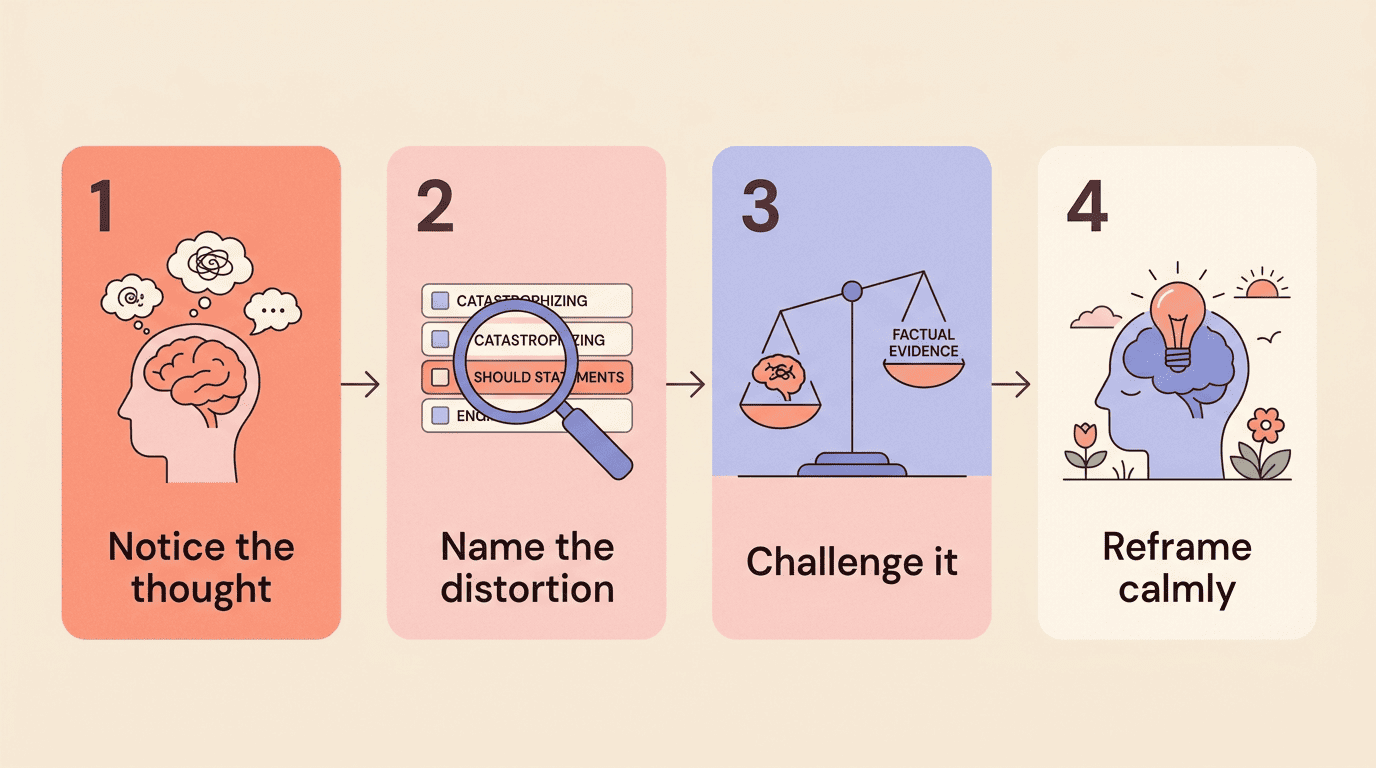
The mechanism behind most of the benefit is cognitive behavioral therapy. An AI psychologist walks you through identifying cognitive distortions — catastrophizing, black-and-white thinking, mind-reading — and challenging them with more balanced alternatives, which is the core loop of CBT. Along the way it can deliver structured exposure prompts and worry logs, the same homework a human CBT therapist would assign between sessions.
Grounding, breathing, and psychoeducation
Beyond reframing thoughts, these tools lean heavily on body-based techniques: guided breathing exercises, 5-4-3-2-1 grounding, brief mindfulness sessions, and support for anxiety-related insomnia. Teaching users what anxiety actually is — a normal, if uncomfortable, nervous-system response rather than a sign something is broken — tends to make it feel less threatening on its own.
Tracking patterns and personalization
Over repeated use, an AI psychologist logs mood and triggers and adapts its suggestions accordingly. A 2025 study led by Michelle Newman at Penn State, published in the Journal of Anxiety Disorders, applied machine learning to 126 people using more than 80 clinical and behavioral factors and predicted generalized anxiety disorder (GAD) recovery with up to 72% accuracy — an early signal of how tailored, data-driven support could get sharper over time.
What the Science Actually Says
Anecdotal usefulness is one thing; controlled evidence is another. Here’s what the strongest available research shows.
| Study | Design | Anxiety result |
|---|---|---|
| Therabot (Dartmouth, NEJM AI 2025) | RCT, 210 adults, 8 weeks | GAD symptoms down 31%; depression down 51% |
| Zhong et al. 2024 meta-analysis | 18 RCTs, 3,477 participants | Effect size g ≈ −0.19, improving to ≈ −0.24 by week 8 |
| Linardon et al. 2024 meta-analysis | 176 RCTs | Anxiety effect size g = 0.26 overall |
Randomized trials show real, short-term gains
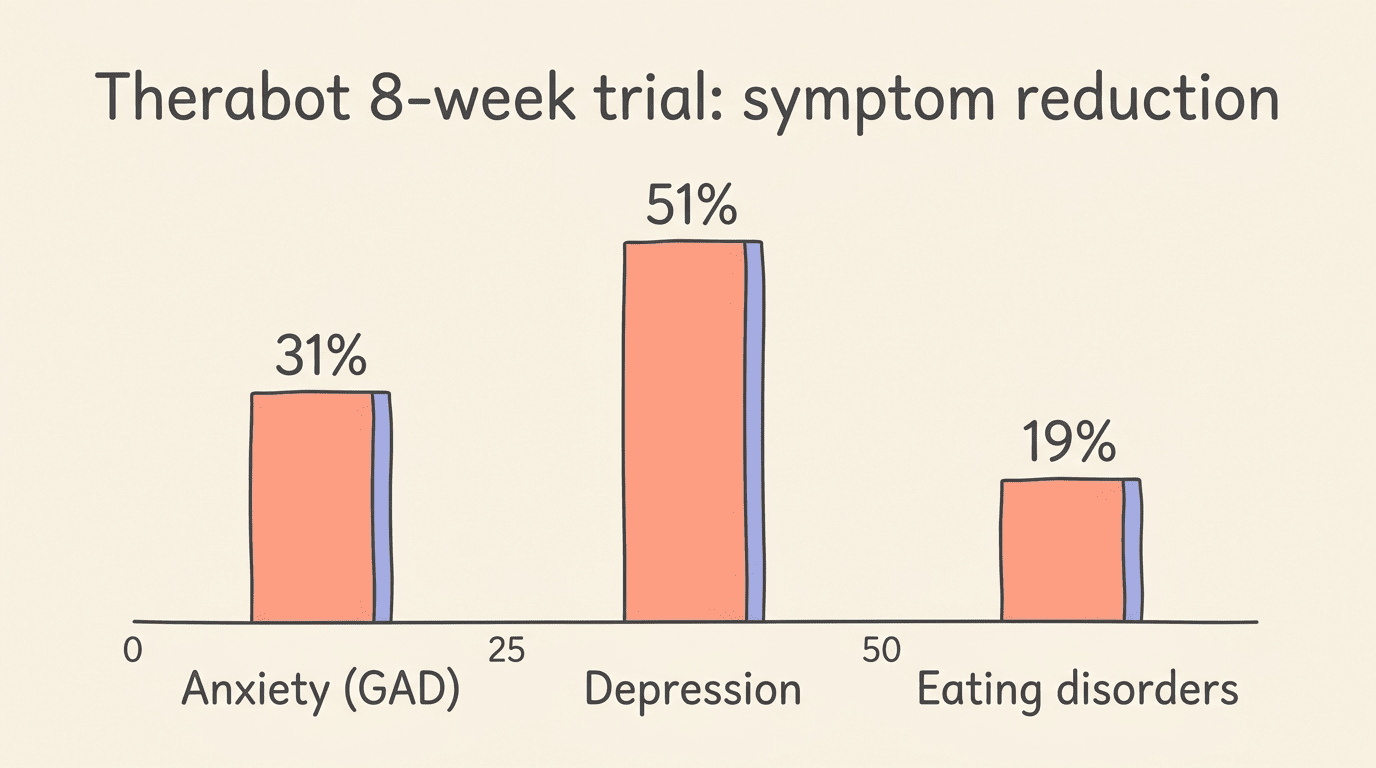
The most rigorous single study to date is the Dartmouth-led Therabot trial, published in NEJM AI in 2025: 210 adults were randomized to Therabot or a waitlist control over eight weeks, with participants using the app roughly six hours in total. GAD symptoms fell by 31% and depressive symptoms by 51% — the first randomized controlled trial of a fully generative-AI therapy chatbot, according to lead researcher Nicholas Jacobson. Broader meta-analyses put typical effects well below that single-trial figure (Hedges g in the 0.2–0.3 range), a gap worth keeping in mind before treating 31% as the norm.
What made the Therabot trial notable wasn’t just the symptom drop — it was the design. Participants texted with the app largely on their own initiative, without a clinician prompting them, and still logged measurable engagement over the eight weeks. That matters because real-world use of any AI psychologist depends on people actually opening the app during a hard moment, not just installing it once and forgetting about it.
The improvements in symptoms we observed were comparable to what is reported for traditional outpatient therapy.
Nicholas Jacobson, Dartmouth Geisel School of Medicine
Meta-analyses: modest but genuine effects
Zooming out from any single trial, Zhong and colleagues pooled 18 randomized controlled trials covering 3,477 participants in 2024 and found a modest but real anxiety effect (Hedges g ≈ −0.19), which improved to roughly −0.24 by the eight-week mark. A separate, larger meta-analysis by Linardon and colleagues (176 RCTs) put the overall anxiety effect size at g = 0.26. Across both, a consistent pattern emerges: effects are strongest at four to eight weeks of use and tend to fade by the three-month follow-up — evidence that these tools work best as an ongoing skills practice, not a one-time fix.
Who an AI Psychologist Is (and Isn’t) Right For
Fit matters as much as effectiveness. The same tool that helps one person stay on track can be the wrong choice for someone in crisis. As a quick gut check, an AI psychologist tends to fit well when:
- Anxiety is mild to moderate and doesn’t disrupt daily functioning
- You’re already in therapy and want extra practice between sessions
- You’ve finished a treatment course and want to keep skills sharp
- You need a low-stakes way to build the habit of naming and reframing anxious thoughts
Best fit: mild-to-moderate anxiety and between-session support. An AI psychologist works well as a first-line daily resource for people managing mild-to-moderate anxiety, reinforcing CBT skills in the gaps between formal therapy appointments, or keeping momentum going after a course of treatment ends.
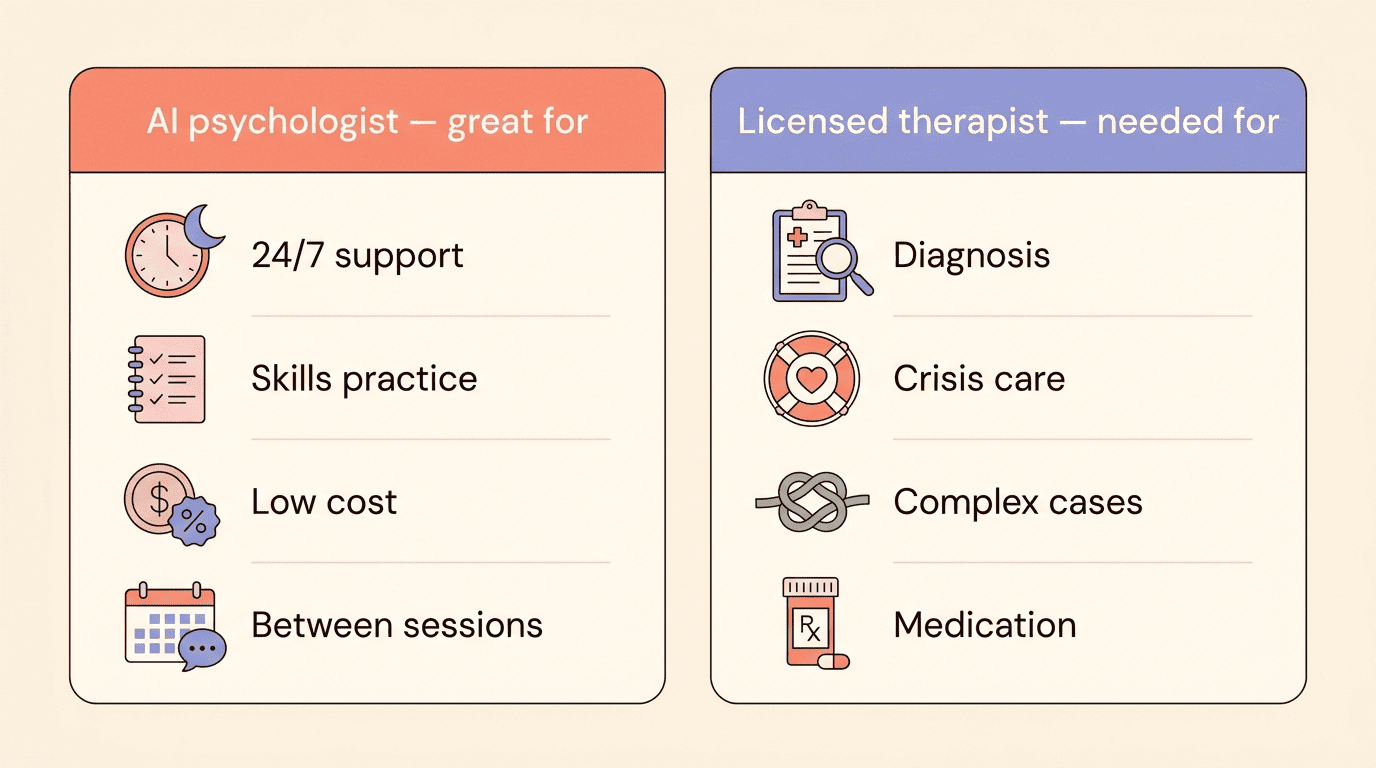
When you need a human instead. Moderate-to-severe symptoms, complex diagnoses, or crisis situations call for a licensed professional, not an app. That distinction matters clinically, too: roughly 50–60% of people with generalized anxiety disorder also have depression, a combination that needs proper clinical assessment rather than self-guided chatbot support.
Limits, Risks, and Safety
None of the benefit above changes one fact: an AI psychologist has hard limits, and knowing them is what keeps it a helpful tool rather than a risky one.
It does not diagnose or replace a therapist
To be explicit: an AI psychologist cannot diagnose a mental health condition, prescribe medication, or replace human care. It lacks the empathy, professional accountability, and clinical judgment of a licensed therapist, and it should never be your only source of support for anything beyond mild, everyday anxiety.
Privacy, bias, and regulation gaps
Beyond clinical limits, there are practical risks worth weighing:
- Data-privacy concerns around sensitive, personal conversations
- Algorithmic bias stemming from non-diverse training data
- A regulatory landscape that hasn’t caught up with the technology
- Inconsistent quality across apps, since not all are clinically vetted
The American Psychological Association has no formal endorsement of any AI therapy chatbot and issued a health advisory on AI chatbots and wellness apps urging caution against relying on generative AI for psychotherapy, diagnosis, or crisis support; the American Psychiatric Association offers a separate App Evaluation Model to help people vet mental health apps before trusting them with something this personal.
Crisis safety — and where to turn
AI is not built for emergencies, and no chatbot should be treated as a safety net during one. If you’re in crisis or having thoughts of self-harm:
- In the US, call or text 988 to reach the 988 Suicide & Crisis Lifeline, available 24/7
- Outside the US, find a local crisis line at findahelpline.com
- If you’re in immediate physical danger, contact local emergency services
- Reach out to a licensed mental health professional as soon as possible afterward
This bears repeating: an AI psychologist is not equipped to handle a mental health emergency, and it should never be the only thing standing between you and help.
How to Use an AI Psychologist Safely
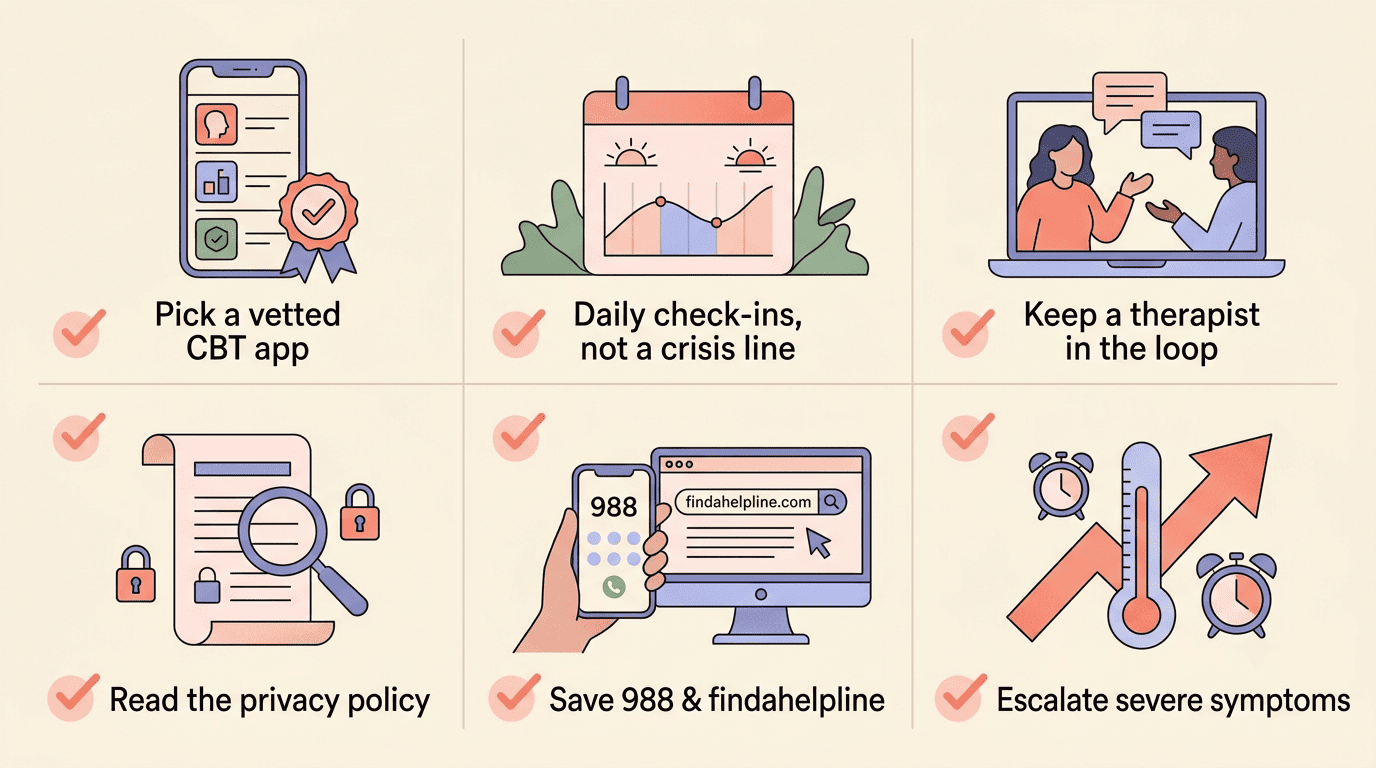
A simple starting routine keeps the benefits and avoids the pitfalls:
- Pick a vetted, CBT-based app rather than a generic chatbot repurposed for support.
- Use it for short daily check-ins and skills practice, not as a crisis line.
- Keep a licensed professional in the loop for anything beyond mild, everyday anxiety.
- Read the app’s privacy policy before sharing personal details.
- Save the 988 Lifeline number and findahelpline.com somewhere you’ll actually find them.
- Treat consistent, worsening, or severe symptoms as a signal to book a human appointment — not a longer chat session.
Used within these limits, choosing to talk to an AI psychologist between appointments can keep your coping skills sharp without ever pretending to be the whole of your care.