
How an AI Psychologist Uses CBT (Cognitive Behavioral Therapy)
Cognitive behavioral therapy works by changing the thought-and-behavior patterns that keep distress alive — and that structured, repeatable format is exactly what makes it the method most AI psychologist tools are built around. It’s also one of the most extensively studied forms of psychotherapy, which is part of why it translates so cleanly into a chat interface. An AI psychologist uses CBT by walking you through the same core steps a human clinician would: spotting an automatic thought, testing the evidence for it, and rehearsing a healthier response.
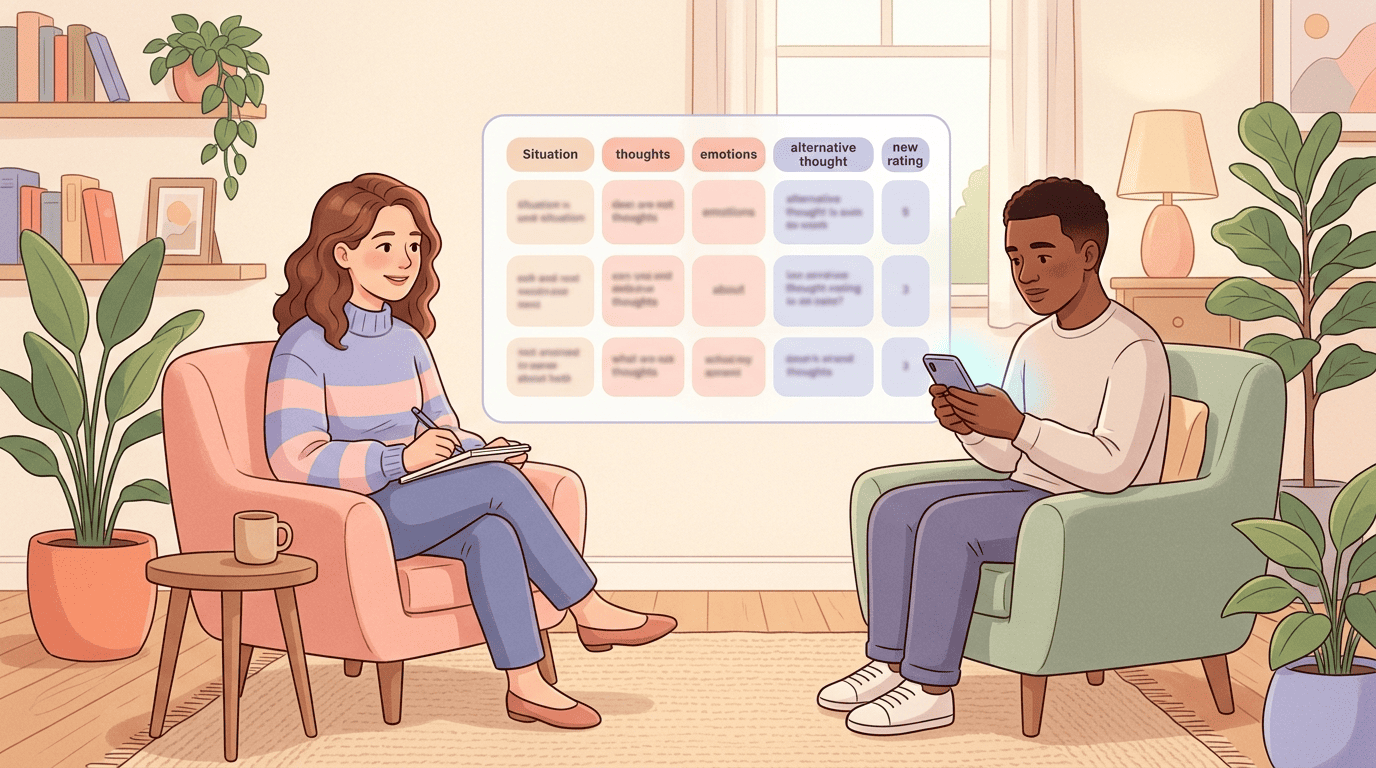
This guide breaks down, step by step, how an AI psychologist actually delivers CBT — the techniques it runs, what the research shows, and where its limits are.
What CBT Is — and Why It Fits AI So Well
Cognitive behavioral therapy isn’t one technique but a whole family of them, unified by a single working assumption about how the mind operates.
CBT in one paragraph
CBT is a short-term, problem-focused therapy developed by psychiatrist Aaron T. Beck in the 1960s, described by the American Psychological Association as one of the most thoroughly researched forms of psychotherapy. It rests on one idea: thoughts, feelings, and behaviors are linked, so changing unhelpful thoughts and actions changes how you feel. A classic CBT session runs 45–60 minutes and follows a clear agenda — check-in, review of homework, a focused piece of work, and a new task to practice before the next session.
Why the structure suits a chatbot
Because CBT is manualized, skills-based, and repetitive — identify the thought, challenge it, practice a response, assign homework — it maps cleanly onto a conversational script. That predictability is exactly what a language model or a rule-based decision tree can reliably reproduce turn after turn. It’s also why reviews of mental-health apps consistently find that the majority of chatbots on the market are CBT-based rather than built on looser, less structured talk-therapy models.
How an AI Psychologist Runs a CBT Session, Step by Step
Strip away the branding and most CBT-based bots run the same underlying script, powered by natural language processing (NLP) and, increasingly, large language models like GPT-4 to keep the dialogue flowing naturally. Here’s how a typical session unfolds inside an AI psychologist chat:
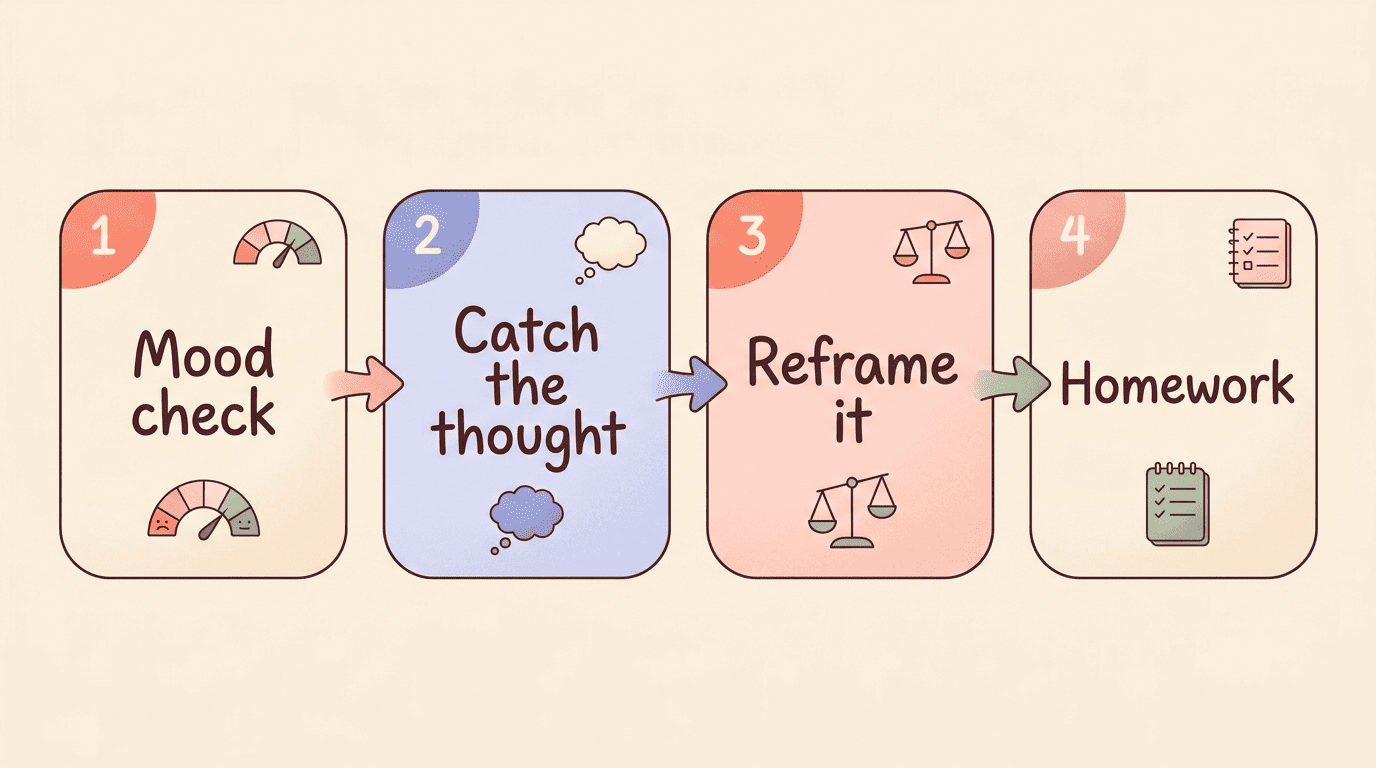
- Check-in and mood rating. The session opens with a mood check, often using validated scales like PHQ-9 (depression) or GAD-7 (anxiety) so progress can be tracked over time.
- Catching the automatic thought. Through guided questioning, the bot helps you name the specific thought behind a difficult moment — something like “I’ll fail this and everyone will see.”
- Cognitive restructuring. The bot challenges the distortion, asking for evidence for and against the thought, and helps you build a balanced alternative — the core mechanism that drives CBT’s effect.
- Behavioral homework. It assigns a small between-session task — a behavioral experiment, an activity to schedule — and follows up next time, closing the self-monitoring loop that makes gains stick.
Working relationship matters here too: reviews of these tools note that even without a human on the other end, users often report a working therapeutic alliance with the bot, which correlates with better follow-through on homework.
Common outcome-tracking tools an AI psychologist relies on to keep that check-in step objective include:
- PHQ-9 for depression severity
- GAD-7 for anxiety severity
- WHO-5 for general well-being
- A simple 1–10 daily mood rating for quick trend tracking
The Specific CBT Techniques an AI Psychologist Delivers
Cognitive restructuring and thought records. The bot guides you to log a situation, the thought it triggered, the emotion that followed, and a reframe — the core CBT worksheet, automated and available on demand instead of once a week.
Behavioral activation. To break the withdrawal–low-mood cycle common in depression, the tool schedules small, rewarding activities and checks whether you followed through, nudging engagement back up gradually rather than all at once.
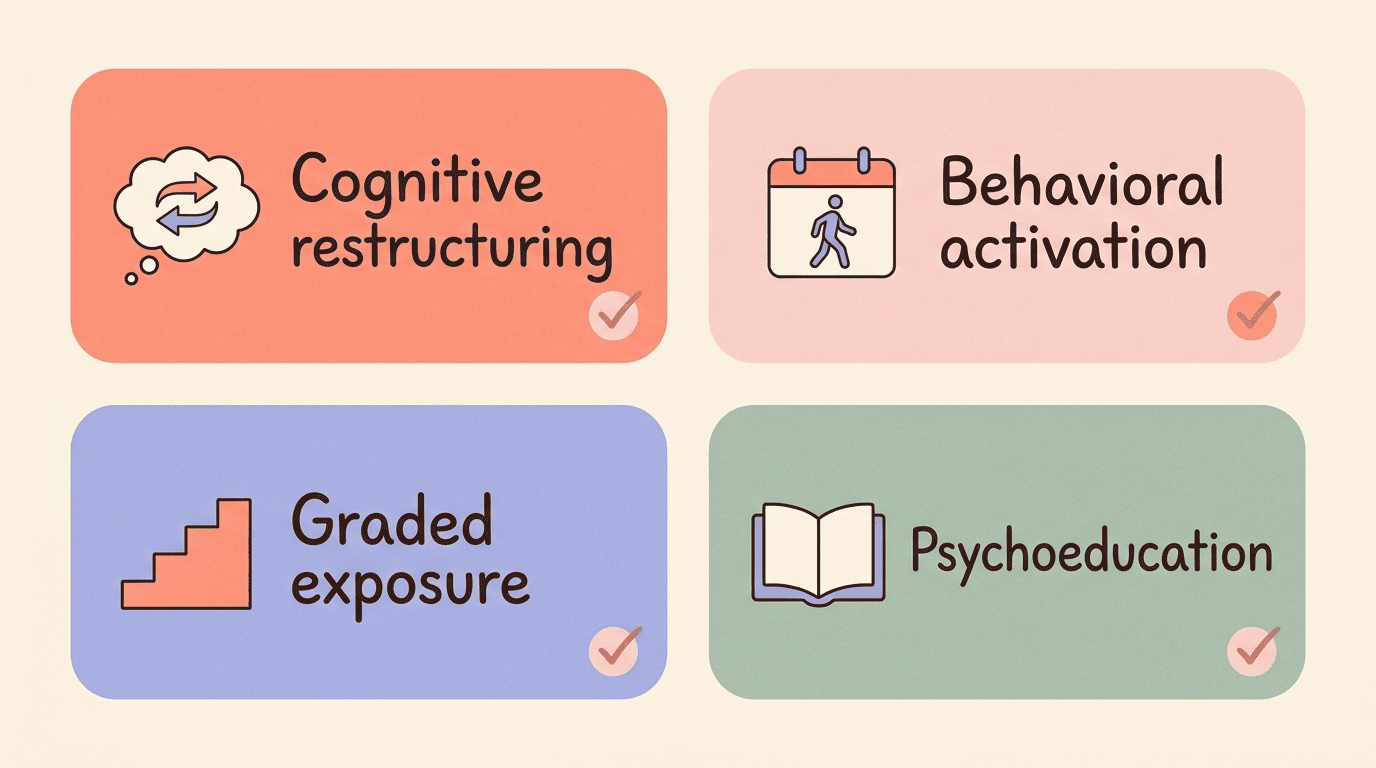
Exposure and relaxation. Some tools add graded exposure prompts for anxiety — breaking a feared situation into smaller, manageable steps — alongside breathing and mindfulness exercises for in-the-moment regulation.
Psychoeducation and self-monitoring. Before assigning any exercise, the bot typically explains the CBT model in plain language, then tracks symptoms between sessions so patterns become visible to you as much as to the tool. The NIMH’s overview of psychotherapies describes this same psychoeducation step as a standard part of evidence-based talk therapy, not something unique to the digital version.
Does It Actually Work? What the Research Shows
Trial data on CBT-based chatbots is still young, but a handful of controlled studies give a real read on effect size rather than marketing claims.
| Study | Design | Result |
|---|---|---|
| Therabot (Dartmouth) | Randomized trial, 106 participants used Therabot, 4 weeks | Depression symptoms down ~51%, anxiety down ~31% |
| Woebot (Fitzpatrick, 2017) | RCT, n=70, 2 weeks | Significant reduction in PHQ-9 depression scores (P=.01) |
| Tess (Fulmer, 2018) | RCT, N=75 across 15 US universities | Reduced depression, moderate effect size (Cohen’s d≈0.68) |
Dartmouth’s Therabot trial
In a randomized trial where 106 participants used the app over four weeks (against a 104-person waitlist control), symptoms of depression fell about 51% and anxiety about 31%, with users reporting a level of trust comparable to a human therapist.
The improvements in symptoms we observed were comparable to what is reported for traditional outpatient therapy.
Nicholas Jacobson, Dartmouth Geisel School of Medicine
Woebot and Tess
Earlier randomized trials support the same pattern: Woebot (Fitzpatrick 2017, n=70) significantly cut depression symptoms in two weeks, and Tess (Fulmer 2018, N=75 across 15 US universities) reduced depression with a moderate effect (Cohen’s d≈0.68). A 2025 narrative review pooling 14 such studies found no serious adverse events attributable to the chatbots themselves.
The honest caveat
Effects are promising but studies are often short and small, and AI is not yet a proven substitute for a clinician when symptoms are moderate to severe. Larger, longer trials are still needed before these numbers can be treated as durable.
Safety, Crisis Handling, and Where AI Stops
None of the results above change one fact: an AI psychologist has hard limits, and knowing them is what keeps it a helpful tool rather than a risky one.
Access vs. limits
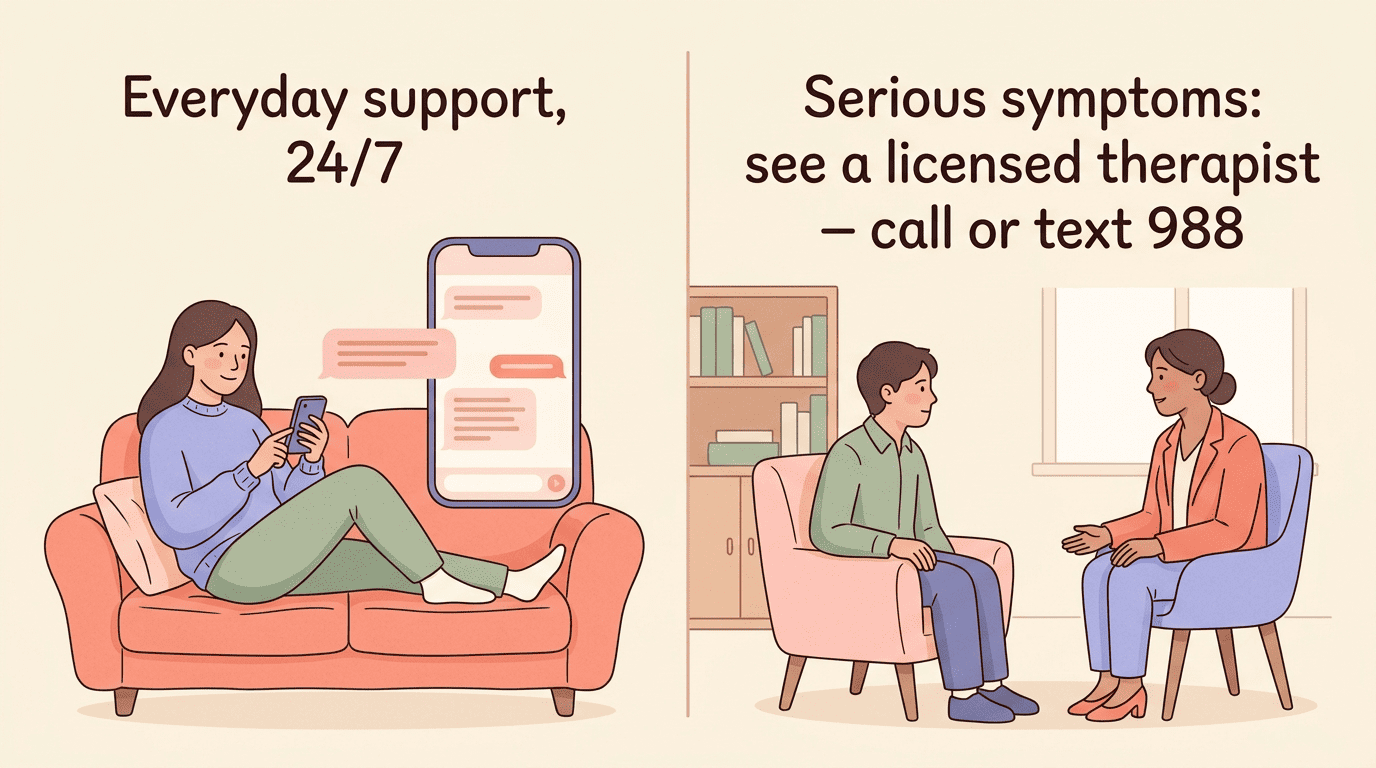
Roughly two-thirds of people with depression worldwide never receive formal mental-health care, according to the World Health Organization, which is why an online AI psychologist can help fill gaps 24/7 — but it complements, not replaces, professional care. The barriers it tends to offset are practical ones:
- Long waitlists for a first appointment with a licensed therapist
- Cost, when insurance coverage for therapy is limited or absent
- Stigma that keeps some people from seeking help in person
- Geography, in areas with few or no local mental-health providers
Crisis detection is not therapy
Good tools screen for suicidal ideation and route users to human help, but they can miss nuance, and no automated system should be trusted as a safety net during an emergency. Signs it’s time to stop chatting and escalate immediately:
- Thoughts of self-harm or suicide, however brief
- Symptoms that are getting worse week over week, not better
- A crisis the bot repeatedly fails to recognize or respond to appropriately
- Any situation involving immediate danger to yourself or someone else
If you are in crisis, contact the 988 Suicide & Crisis Lifeline (call or text 988) in the US, or local emergency services immediately. The 988 Lifeline is staffed by trained counselors around the clock, at no cost.
Disclaimer
An AI psychologist is a self-help and educational support tool. It is not a licensed clinician, does not diagnose any condition, and does not replace therapy or medical care. For anything beyond mild, everyday distress, treat it as a complement to professional treatment, not a substitute for it.
Examples of CBT-Based AI Psychologists
Not every tool on this list works the same way — some are commercial apps, others are research prototypes still under clinical trial.
| Tool | Category | CBT focus |
|---|---|---|
| Woebot | Commercial, rule-based | Structured CBT skills via scripted chat |
| Wysa | Commercial, rule-based | CBT + mindfulness exercises |
| Youper | Commercial | CBT blended with mood tracking |
| Tess | Research-grade psychological AI | Conversational CBT support, studied in RCTs |
| Therabot | Dartmouth clinical-trial bot | Generative CBT dialogue, randomized-trial evidence |
Woebot and Wysa deliver CBT skills via chat using pre-approved conversation flows; Youper blends CBT with ongoing mood tracking; Tess is a research-grade psychological AI studied in university-based trials; Therabot is Dartmouth’s clinical-trial generative bot, the first of its kind to run a full randomized controlled trial. All five center their design on the same core CBT techniques described above.